You Need Not Finish First, To Be a Winner!

Having just experienced a particularly hard and slow run, I’m prompted to recall one of the great joys of Mid-Pack Running: everyone can be a winner, if they just choose to be.


  • A good-for-you finishing time is a win, regardless what that time would mean for any other runner.


  • A new and longer distance – even if your pace is slow, or you end up staggering, stiff and sore – is a victory!


  • A new and shorter distance can be a victory; a chance to unleash your inner-sprinter and see how a new pace feels.


  • Every new (to you) event is another unique memory added to your life’s experience – another notch on your bow.


  • A new route you run in training is discovering a piece of this world from a perspective different than walking, driving or riding can ever afford. Score!


  • That familiar run you’ve done before is a great opportunity to coach the first-timer on the shuttle seat beside you – feel like the wise old pro for a few minutes, and do some good as well!


  • Any run is an opportunity to make a connection with other runners – it’s a huge world out there and we all feel lost and insignificant at times, but if you run, you’re a member of the running community, regardless of division, place or pace.


  • Did you run according to the plan you made in the weeks before – you’re a winner!


  • Did you push on thru – despite your plan falling apart – you’re strong and resilient and maybe learned a thing or two. Score.


  • Was there one moment when it all seemed to come together, one glimpse of fluid motion where your body knew what to do better than your conscious mind – remember that feeling and seek the path to feeling it again.


  • Perhaps one mile-marker came up sooner than you thought it would – or you completely missed noting one because things were going so well that making the next mile no longer seemed like life or death – all that conditioning worked!


  • Maybe nothing particularly good happened today, but you completed what you set out to do without injury or worrisome little suggestions that some body part was about to go spring? Congratulations – with all that life can throw at a person, any day we can run is a good day!


  • Everything went wrong but you mustered a last tiny something to finish strong – in my book, that’s a triumph…


  • “Well actually, I barely dragged my sorry butt across the line….” You finished despite everything – that’s a triumph! Make yourself the hero in your own inner-movie.


  • Just couldn’t summon up the gumph to finish? Remember how far you did go – and know that’s farther than the majority of the populace will ever do! (Could be time to start dreaming about the next run: recharge, recalibrate, and bring in some other resources to help you train so you can do better – finishing next time will be all the sweeter for having had this experience.)


  • Injured? Every runner has their injury story, and this is yours now. Remember that the ending is what makes a story – treat yourself wisely, recover well and if you can come back another day, what a tale you’ll have to share – and maybe offer it up to help someone else when they are down and out!


  • Really can’t find anything worthwhile on your side of the run? Try giving back to the spectators and volunteers – this is always important to remember, but especially if things are not going well: the best way to get a shout of encouragement is to holler “Thank you volunteers!” as you stumble past their stations. Just might lift your mood a little, and the body is connected to the mind….


  • For that matter, a lot of running events raise funds for charities – so even if all else fails, your participation helped a good cause.


  • If nothing else, you spent some time in the fresh air, among enthusiastic energetic people, and not on the couch – in today’s privileged western world, that is a blessing and an achievement right there!


  • Tired and exhausted after a big run? Compared to the weariness of stress and workaday demands, just feeling truly physically-tired is a rarity and a victory all of itself. Maybe you’ll sleep a little better tonight


Mid-Pack Running is what you make of it; victory is ours to define – every day, every mile – and if you ask me, EVERY RUNNER IS A WINNER, EVERY TIME!

One More Time

(I know this is just a tiny echo from a much, much larger and more-profound story, but it’s my echo, and after trying many times, this is the best way I’ve come up with to tell it.) 

ONE MORE TIME

Your wake up early to run a big-city marathon –

Early enough to pick up your phone in the darkened hotel room and check the weather, then shave and sunscreen before putting on the clothes laid out the night before –  Smear your toes with Body-glide to fend-off blisters, before pulling on socks and the shoes that have been broken in just right. Early enough to gather up extra warm layers and hat and gloves for the trip to the start, and energy-gels and water bottle and music player; to touch your wife’s sleeping shoulder so you don’t wake her, and whisper ‘Goodbye,’ before stepping out into the silent and deserted hallway, shutting the door as quietly as you can.

Familiar tasks, that you’ve done before, – not because you’re some kind of natural-born athlete, or an athlete at all.  No, you actually got into it because you were turning fifty and your 12-year old towered over you and your business had slowed to a crawl after 911 even as your country was sliding downhill into war and it all made you desperate for something – anything – that felt like moving forward.  The first marathon hurt like hell, but the atmosphere was electric, the energy and optimism of all those vibrant persons, and that part clicked, so that you wanted to try it one more time, to see if you could do better.  And when you actually did worse, that drew you in to do it one more time, and then one more,

And every time, there came a point somewhere along the distance that it seemed it would never end, where you told yourself ‘this is ridiculous, I’m not made for this, I will never ever do this again.’  With the result that, when you happened on a chance to run here – in the big-time – you said, yeah, that’ll be a good way to end it all. One more time, and then it’s over: you don’t ever have to do that to yourself again.

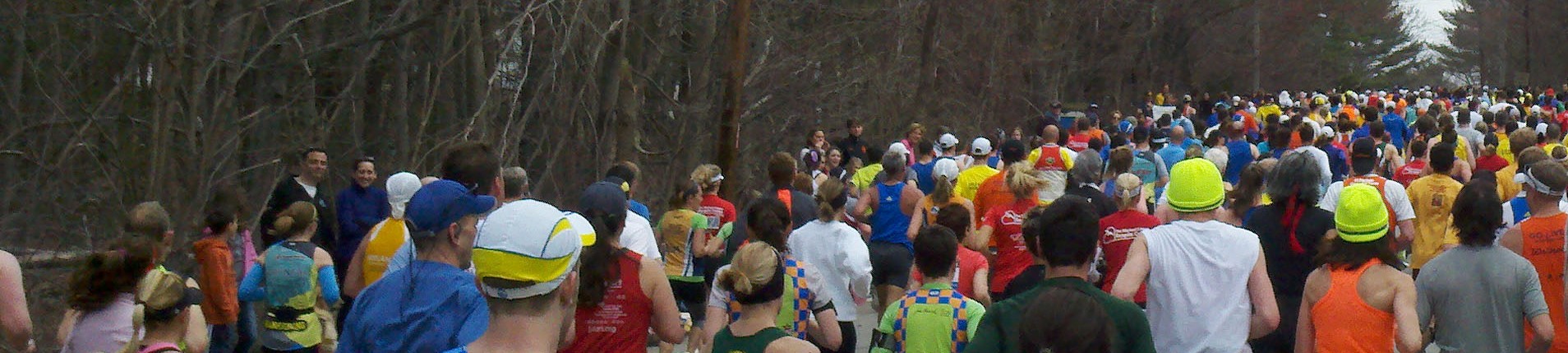
Which is what you’re thinking out on the street and in the coffee shop, where half the people you see are other runners heading for the subway, which takes you to the park where 20-some-thousand people are converging to board the hundreds of school buses arriving like clockwork and where you find yourself next to two women who are also from Colorado, and as you chat and watch the sun come up along the highway, you all know this is going to be a great day.  Filing through security; milling about a high school campus that’s been organized like a military marshalling yard, you feel the excitement, see the smiles and anticipation on thousands of faces. The armed soldiers on the school roof seem like overkill, as do the sniffer dogs being handled through the crowd. A couple hours of shivering and finally the sun is starting to warm the treetops as your wave – the last and slowest wave that is – make their way through the usually-sleepy side streets to jam up behind the tape.  Music is playing and everything is under control as your group reaches the line, then a gun goes off and you’re running again, along with several guys doing the distance in combat boots, fatigues and field packs; six kids in hamburger suits, and twenty-six-thousand of your closest strangers.

Along the way you stop a couple of times to take photos of the hoard – never brought your phone on a run before, but since this is the last one, and since it is the big time, it seemed like a good idea, and it lets you catch a photo of the sign for Framingham – where your father returned again and again for surgery after the war, which connects in your mind with the uniformed servicemen and women controlling traffic at many of the cross-streets.  There are a hundred little things like that to see and remember, but mostly it’s the continuous cheering crowd lining both sides of the route, with their signs and high-fives and kids reaching out for hand-slaps as you pass by, that make it feel like coming home, generating warmth not just from the rising sun or the sweat, but from the good will pouring out all around you.

Around 22 miles you look for Jennifer, on the corner the two of you picked out with Google Earth, and there she is, camera pointed. A quick hug, a hearty kiss, wisecracks from the people standing beside her, and you’re off again knowing now the goal is to spend these last few miles burning up whatever strength is left, to get the most out of this one last time and the pulsing humanity lining both sides of the course, now two and three deep.

The closer you get, the deeper the crowd is, and louder, voices bouncing of tall brick buildings, fueling you to think “it doesn’t get any better than this,” this glorious celebration and welcoming – four-hundred-thousand people, the press predicted – pouring out their goodest-good-vibrations for strangers and family alike, a festival of community as you make the final left onto Boylston and get your first glimpse of the finish three-and–a-half blocks away.  The emotion builds as you push still harder, breathing locomotive-loud with every footfall, heart beating like it wants out of your chest and your only goal is to drain out as much of yourself as you can, to be spent and exhausted at the end of this road, and then in an instant you’re across the line, legs stuttering to a stagger.  Someone hands a bottle of water as you try to stay upright and get some air into your lungs, then, another volunteer puts a plastic cape around your shoulders as she tells you to keep moving. Farther down the block, they hand you a medal to drape around your neck, and despite the fact that every limb is screaming with pain you begin to really feel the glow of triumph and self-satisfaction, to realize what a great day this is – one of the best days of your life – when  POOMF

Not Blam! or Bang! or any other comic-book-speech-bubble-sound, Not thunder or earthquake or ground moving beneath your feet, or even very loud, really.  Just ‘POOMF’, but a sound so out of place you know in an instant what it is, and when you turn you see down the block the back-side of the finish line arch, with dozens of people strung-out between here and there and every one of them turning just as you are, to stare at the column of white smoke rising from where, two minutes before, you passed the shoulder-crammed crowd of spectators.

‘Maybe a gas line burst,’ someone says hopefully, and you say no, that wasn’t a gas line, because you know – but of course you’re wrong: it wasn’t a vest and it wasn’t a belt.  It was a backpack-filled-with-pressure-cooker-filled-with-fireworks-nails-and-ball-bearings.

Which is also not a gas line.

Where’s Kathy?’ one runner cries out – or maybe it’s ‘Mary’ or ‘Judy;’ the name doesn’t mean anything to you but the point is crystal clear.   ‘She was behind me,’ answers another, and whether one of them says ‘Oh my god,’ or you just think it, the meaning is the same as in your head you do the quick math – Jennifer was at least three miles back of the line; however long it took you to run that, it’ll take her a lot longer to walk it, so there’s no way – unless she hopped a  bus or took the tube…. You pull out the phone – which you never take on runs but you did today because it was going to be the last one – and text her, just the letters: “I M O K R U”’, but the first time you check for a response, the networks have gone down and it will be hours before you receive or send another message.

There are no sirens yet, just a murmuring stream of runners, and the race workers urging you all to keep moving, their voices calm and gentle as if nothing at all has really happened.

You start walking again, dazed and confused, body starting to chill though you don’t quite notice it yet.  You’re farther down the block and it all seems kid of distant and unreal until POOMF -a second time, and this is when it truly hits home; in this moment everything else about this day seems suddenly small and silly and pointless, as you seek-out the nearest stable object and grab-on tight with both hands, the words clearly verbalized whether the syllables come out of your lips or not – “people are dying, right over there” – while your entire body starts to vibrate and the tears come, the first time.

By now the sirens have started, distant and inconsequential at first, like they could be any city street any time of the day or night, except they continue and multiply as you heed the volunteers’ instructions to keep moving away.  Moving away, under a darkening sky; sun hidden now, wind picking up; reminders of the morning’s cold; or the cold of midnight; the cold of things that end forever.

As cold as you soon become, focus is impossible; it’s half an hour before you remember the long-sleeved shirts tied round your waist miles ago and fumble them on, though they do not help at all as you arrive at the lamppost you and Jennifer had scouted for a rendezvous, to find her nowhere in sight.

It’s an hour from the moment – an hour of no cell service and no word from Jennifer, who you’re so sure was far from the scene, and yet so not-sure at all – an hour of listening to people trying to figure out what’s happening, the news so far all cryptic, half-conjecture – before she appears out of the chaos to find you shivering and blue-lipped, arms-wrapping and feet stomping to try to get warm, and seeing her face and feeling her hug is about as welcome as anything has ever been.

It’s maybe two days later, that someone asks – do you want to come back?

One more time,” you were thinking, waking up in that darkness. “One last time and you’ll never need to put yourself thru that again,” but now the answer comes in a heartbeat: “absolutely”.  To hear that crowd, to run that last hundred yards past where it all went down?  To stab a middle-finger in the eyes of the impotent losers who did this to all those beautiful smiling spectators? Damn right you’re coming back.

It’s maybe a month after the day that you realize you were wrong – about everything else being small and silly and pointless. When yet-another person asks you what it was like and you realize you don’t want to talk about the tragedy, because that gives the idiot bastards too much credit. What you want to remember and to tell about is the crowd that day, the outpouring of support and encouragement and what certainly felt like a kind of love.  About how it was really those spectators who were targeted, who paid the most in blood and sorrow, who deserve to be remembered, and they who make you want so badly to do it all again.

Which is why, six weeks after the day, you run again in another town, and find something has changed; despite it being as hard as ever, there’s a sense that this is now something you do, has become a part of you, though underneath the handshakes and smiles of the finish line you feel the emotion bubbling up from the deepest places inside, and sneak off into a nearby alley to huddle in a doorway as the tears return; not for the last time.

At  five months after, you apply to go back, only to learn that so many people want to run that first-year-after – so many people want to thumb their noses at the fiends and all their like – that you don’t quite make the cut-off.

And so you suck it up and train harder and run more, and now – a month from today; two years and five days after that moment,– you’re gonna get to go back and do it again. Travel those same roads and tour those towns and campuses; turn that same final corner feeling the warmth of that mass of humanity and shout ‘THANK YOU’’ and ‘BACK-AT-YA’ to them, for being there, year after year – though no one ever gets a medal for spectating. To honor and to thank them for coming out again to welcome thousands of strangers into their city –

ONE MORE TIME
Faster Is Not Necessarily Better

So you’re maybe feeling confident about going the distance, in pretty good shape for the person you are, but as an MPR, there are an awful lot of folks finishing ahead of you – some of them your friends, some of them older, some pretty casual about training, and some of them rank-beginners apparently possessed of a natural ability to cruise blissfully by as you’re huffing and aching…  Wouldn’t it be great if you could pick up the pace some more, cut those times?

Speediness envy is lurking out there, searching for chance to corrupt your mind and body.

Well OK, it’s not exactly The Last Temptation, but as I sit out another weekend of severely-limited exercise, I’m forced to consider – is trying to get faster worth risking an injury?

(Quick replay: to build speed in the weeks before a much-anticipated event, I added a mid-week interval workout, and amped up the calisthenics (lunges, steps, planks, etc.)  on non-running days.  A big long-run ten days ago went well, with just a slight soreness in one hamstring.  Couple days later, calisthenics OK, but definitely working the muscle-groups hard; a healthy soreness afterward. Next day, an interval workout on the treadmill (which happened to include breaking-in a new and supposedly-faster shoe), also went well, though that hamstring started complaining toward the end. Next morning? Could barely walk for the bowstring-tight screaming cable in the back of my left leg.  Rest for two days and head out on a gorgeous sunny morning? Couldn’t jog a hundred yards!)

Two lessons I’m going to try to learn from this:

Number one – Blame the new shoes!  Juuust kiddingggg; actually, since I tried them right after starting the new calisthenics and at the same time I was peaking mileage and pushing the pace in intervals, there’s no way to tell which of four different factors led to the injury.

Note to self: change one thing at a time to isolate the effect – and give it enough time to play out for good or bad before trying something else.  Otherwise you’ll never know what made the difference.  And knowing that will make all the difference, as recovery tapers into resumption.

Number Two – Ten days of reduced activity and I’m pining for the endorphins, the unique warmth-from-within generated by muscles converting glucose into movement, the satisfaction of having completed a good workout.  Right now I’d gladly tack some seconds onto my pace, just to have a pace!

So, a new addition to the list of MPR credos: it’s better to run less fast, than not to run at all!

A More Detailed Game Plan

Running-writing is filled with things to do – tempo runs, long slow runs, intervals and fartlek; train for speed, train for strength, train for endurance; hydrate  – but don’t over-hydrate or you’ll get hyponatremia! Take in this many calories based on your body weight – but be careful what you ingest and how much, so it doesn’t upset your stomach.  Shorten your stride or increase your cadence, land on the mid-foot or the forefoot or underneath your body; make sure you…

How can anyone keep track of all that in the middle of a jostling crowd or a twisting, turning trail?

Regular training that builds-up a base of experience is a big part of managing all this information. Consciously trying out something in a training run, then next time varying it – or doing the opposite – is the best way to figure out what works for you.

Event day, though, is no time to be trying things out; which is why we need a game plan – a clearly-formulated idea of how you intend to run that particular event.  A recent big event reminded this MPR of the need to make that game plan more detailed:

Going in, I had a specific target time in mind, and trained for that pace at that distance.  Knowing nutrition would be a big part of making my goal, I planned, tested, and prepared a belt with two bottles of energy gels, slightly-diluted so they’d go down more easily in the brain-dead later miles.  I’d carbo-loaded for two days (not overeating; just moderate amounts of food but with a higher percentage of carbs than normal training diet, like the articles said)  Race day, and the first half went great: on pace, never feeling depleted, but a couple of miles later came the dreaded ‘bonk.’  Pull out the fuel bottle, take some in – no effect.  Grab something to eat at an aid station and it felt marginally better for a little while, then ‘bonk’ again.  And because it was late in the race and the ‘bonk’ had already hit, it was a struggle to force anything down – nothing seemed palatable, even though I knew I was in desperate need of calories!  Perfect recipe for a disappointing day.

The problem?  I’d planned my fuel source, but not when to take it in.  Training runs since then have been experiments in fueling early, before it feels necessary.  That seems to work, so next event, I’m scheduled to take in a gel (or equal) at the start, and another one every two miles, whether it feels like I need it yet, or not.

Same thing can apply to hydration – if a run has aid stations every two miles, you might schedule yourself to drink a cup of water at one station and electrolyte at the next, alternating the whole way.  If the aid stations are farther apart or you know you need more fluid, you might plan to drink two cups at each one.  If you’re running a long distance for the first time, you might plan to walk a hundred yards while you drink at each station to give your body a chance to relax back into form.  Or do that every two miles by the markers, or…

Just don’t leave it to ‘what feels right at the time.’

Don’t know about anyone else, but my brain simply doesn’t work as well during an event. Adrenalin, distraction, fatigue and excitement can all cloud one’s judgment, so the more we plan it out and give ourselves one or two simple rules for the day, the better odds of having it end the way we’d hoped.

Having a game plan, and making it as specific as you can, will increase your probability of a successful event!

(At least, that’s the plan…).

Run for Your Life – But Don’t Count On It

  There is a time for being ahead, a time for being behind; a time for being in motion, a time for being at rest, a time for being vigorous, a time for being exhausted;*

 There’s a small lake near my home, with a ¾ mile paved path around it – perfect for tempo training – and overlooking that path is the home of a woman with the long, lean sort of build you might well pick out of a crowd as a being a natural-born runner, who sometimes waves or shouts encouragement as I go tootling by. She did in fact run competitively from high school thru early-middle age, though no more; her hips; she says, just cannot take the pounding…

One reason I’m still able to run may be that I started quite late in life, encouraged by a good friend who’d been running shorter distances for decades, and wanted to step up to a hemithon.  We trained and finished that event almost a dozen years ago, and several more together, till he ran up against a string of injuries. Now, after his only-semi-successful knee surgery and therapy, we find other thing to do together, besides running…

And then there are those moments sitting at the desk or on an airplane when you move your feet and feel a twinge on the inside of one knee.  Or the first steps of a run, where one ankle seems about to crack, so you vary your stride and hope it goes away once things get warmed-up a bit.  The hip feeling ‘wonky’ as you walk down the stairs for morning coffee.   The trail-running tumble last summer that initially seemed like just another case of road rash, but now you’re wondering if that shoulder is ever again going to have the same range of motion as the other one…

The possibilities, unfortunately, are endless, and so, on this cold and damp and grey morning-of-the-tired-legs, when I can readily come up with multiple excuses not to get out there again, my better-self reminds me to:

Run like you’ve been running all your life; it’s natural it’s healthy; it’s one of the things our bodies evolved to do;

  • Run like you will be running all your life;
  • But don’t ever take it for granted –
  • Don’t ever count-on being able to do it forever, because you know that an injury could end your career at any time,
  • And, as a direct consequence of that knowledge: make the best of every day on which you can get out there and pull one foot off the ground before the other one touches down.
  • Be all the more grateful for knowing how precarious that gift is.

Run for your life!

(* Stanza 29, Tao te Ching, A New English Version, by Lao-Tzu as translated by Stephen Mitchell, Harper & Row, 1988)

Run-up to Boston – Part 5 – That Crowd!

I’d read about it before my first trip to Boston, but nothing in print prepares one for the reality, which includes:

Homeowners and compatriots hooting and encouraging from their front lawns as you leave the holding area at a Hopkinton school yard to walk the half-mile or so to the actual starting corrals.

Friends and family six-deep and more at the start, snapping shots of loved ones as they finally find enough open pavement to break into a run, bursting with energy pent-up thru several hours of waiting, queuing and standing shoulder-to-shoulder.

Barely as much as twenty feet of unoccupied curb on either side for the entire distance.  (Except one thinly-wooded stretch early-on, where lots of male runners were stopping relieve themselves, barely off the route and not at all concealed – come on guys!)

Service-women and -men in uniform controlling traffic at many of the side street intersections along the way; a great honor to be so cared-for by you.

The colleges: yes, there are hundreds of college students in Wellesley and Boston College, generously offering the kind of hysterical enthusiasm that comes from being cooped up on small campuses with large expectations.  Much appreciated!

Signs – some clearly aimed at a particular runner, but tons offering non-specific encouragement, with the result that even an out-of-towner feels like they are running thru family and friends the whole time, making this feel like a home-town event, no matter where one hails from.

The volume!  You want to plug-in for extra encouragement thru the late-teen miles? Fugeddabout it!  Not only is it impossible to hear over the crowd without cranking-up to a head-splitting level; it quickly becomes clear that not even Born To Be Wild is as effective a spur as all those voices and faces!  Plug-out and observe; this is priceless

Crescendo – by mile 22 or so, the bigger buildings are closing-in, the crowds even thicker and the volume just continues to grow, equally-heartening whether you are struggling to hang on or ready to start squandering some hard-won hoarded reserve for a strong finish.

Rounding the turn onto Herford street it seems like it can’t get any better (visions of Olympic rings and Super Bowl trophies may come to mind, as you picture your own private ‘Miracle on Ice’), until that final left onto Boylston kicks you in the shorts even more.  How can you not give your all to these people who fill the sidewalks, standing in the cold, or rain, or baking sun, beaming their own personal energy and emotions out to supplement whatever you have left?

Which brings up a somber thought: none of the reporting I’ve seen about the tragedy of 2013 has sufficiently emphasized that the bombs were placed not on the course, but in the midst of the spectators at the finish.  The majority of those injured that day – and all of those killed – were not runners at all, but people who had come to cheer them on. People who would get no medals that day, would have no finishing-time to put in their logbooks; who were only there to encourage others.

And the next year, the crowd was bigger than ever!

Running a marathon is in many ways a selfish pursuit; spectating at one is just the opposite; an act of generosity and even love.

SO THANK YOU BOSTON CROWD, YOU ARE WINNERS, EVERY ONE! 

This Little Piggy Got…Stormsocks

So you’ve got great running shoes that fit just-right with the type and weight of socks you like to wear, and along comes cold or wet or wind – or some nasty combination of the three.  Do you spend a hundred-exty bucks for a new pair of shoes sized-up to fit a couple pair of heavy socks?  Or maybe even more for ones with a Gore-tex interlayer that makes them (somewhat) waterproof?  Tough it out with wet cold toes?  Or just hang it up until the weather clears?

Stormsock

Another alternative, and one I think is the best of the bunch, is these Hyperlite Stormsocks, by Seirus.  They’re thin enough to fit in your regular shoes, over your regular socks, and as far as I’ve found they’re totally effective at keeping out water, snow and wind.  In fact, it’s kind of interesting to step in a frigid puddle with ‘em, ‘cause for a second you think your feet are getting soaked, then a moment later you realize they’re totally dry – it was just the rapid heat loss due to water being more dense than air, which goes away as soon as you’re no longer stepping in it and the normal bending motions of running squeeze most of the moisture out of the fabric and padding of your shoes.

And the best part?  Unlike a water-proof shoe, Stormsocks are tall enough to protect your ankles as well, and prevent gaper-gap with running tights (I put the socks on first, then pull tights on over them to keep it all sleek and make sure any water that rains or splashes onto my legs will run down outside the Stormsocks, not in.  Though they’re not insulated, that extra layer adds warmth too – I’ve run in very thin low-top socks plus these, in shoes that have really-open mesh uppers for summer ventilation, and been comfortable on icy roads in temps down in the twenties.  Only below about twenty five do I switch to a pair of calf-high wool-blend socks (Seirus makes those too, as do SmartWool and others) with the Stormsocks on top to cut the wind.  If it’s too harsh outside for that combo, it’s time to take up mushing.

They say in life, it’s the little things that count; so if you want to keep on runnin’ when the weather gets sloppy, I suggest you get your little piggies to market and pick up some Stormsocks, pronto.

In Control of Your Goal

In soccer, one goal is a big deal; in basketball…not so much.

In running, goals are not the be-all and end-all as they are in ball-sports, but they’re very useful motivators.  Over time I’ve come to believe that three goals is the perfect number for an MPR to consider for any event.

Goal Number One is what you have been training for and realistically believe you have a good shot at making. It may be modest or ambitious, but it is generally quite pragmatic and objective, like:

To complete a distance longer than you’ve done before

To finish under a certain time

A new PR, even if by seconds

A new PR, at a specific time or pace


Goal Number Two is the dream – not only making your Number One, but even surpassing it.  We don’t hit this one very often, but when we do, it can be a lifetime memory.

PR by some significant margin

To place in your division

To complete a distance that used to be a struggle, and do so with the feeling that you own it; that from now on it’s no longer ‘can I do it?”, but ‘how well can I do it?’


Goal Number Three is the fall-back:  if  things go wrong, and you see goal Number One slipping out of reach (and goal Number Two starts to feel like a cruel tease you’ve played upon yourself), having (or improvising) a strategy to salvage the day can be a crucial motivator.  This is also where the MPR attitude comes into play: we are not out to ‘win.’ We are not out to beat any other person. We are out to demonstrate something of ourselves to ourselves, and to experience the experience.  With that in mind, Goal Number Three might be:

To match the time you had in a similarly rough run last year

To at least be under XX time; some significant-sounding roundish-number which is short of your original goal, but seems do-able in the thick of today (‘recalibrating’ your goal)

If you’re on a new or more challenging course or distance, then just to complete it

If you’re on a distance or course you’ve struggled with before, then to finish without it feeling as much of a struggle – even if your time is not  what you had hoped (note: this is a very worthwhile goal, and too often ignored in the push for a specific time)

To keep a certain pace for at least part of the course

To ace one part the course – a strenuous uphill, a technical downhill – even if the rest of the day is not so great

To have enough juice left to make a push in the final half-mile (or hundred yards, or fifty, or ten!)

To still be running at the finish line (there are days….)

Simply to finish the distance without injury, ready to go back out and train some more for another day (again, a very worthwhile goal).  For an MPR with eyes open to the big ol’ world out there, any day we can run, is a good day!


What is important about an Goal is that it be meaningful to you; that it reflects why you – individually and uniquely, you – are running at all.  Something you can choose and achieve(or not) regardless of how well others may do that day.

Which is where MPRs differ the most from Lead Dogs: a Lead Dog’s success is highly dependent on how the other dogs do.  MPRs are in control of our goal(s), and that is a grand place to be! 

Run-up to Boston – Part 4 – Why Bother?

Run-up to Boston – Part 4 – Why Bother?

One thing – maybe the thing – that makes Boston different from nearly all other marathons, is the qualifying requirement.  Where other events welcome all comers, and manage their numbers – if necessary – via lottery or ridiculously fast sell-out, Boston is unabashedly elitist, using its multi-tier registration process to ensure it admits only the fastest of those who apply each year, which pretty much guarantees that MPRs who make the cut at all will start and finish at the back of the field.  Yup; a person used to finishing in the middle of the pack at other events, could well find herself a ‘squeaker’ here, lining up in the last wave wearing bib number 26,236 out of 28,000 and, thanks to the multiple waves with multiple corrals in each, finishing hours after the big names have received their awards and headed for the showers.  On top of that, it’s expensive to travel and stay in Boston, an hours-long cattle-call getting to the starting line (which temporarily consumes the tiny town of Hopkinton like a nebula-cloud enveloping the Starship Enterprise), almost impossible to find friends at the finish, and requires seven to 14 months of forethought and planning.  So why bother?  Well, there’s…

Bragging rights – to a lot of your family, friends and people you meet now or in the future, the Boston Marathon may well be the only running event they know by name (except perhaps the Olympics, which is even more difficult to get to).  Civilians who know nothing else about this sport (pastime? addiction? religion? – whatever it is to you) will know that running this one is a landmark, so being able to say, with utmost casualness, ‘yeah, I’ve done Boston’ is one of the most satisfying ways to reassure yourself that you actually are ‘A Runner.’

Schwag – the BAA folks, who put on this event – have great taste. Their unicorn logo is cool in an ‘old-patrician-establishment meets new-age-mysticism’ sort of a way, and pulling out your participant shirt is always reassuring after a disappointing workout.  I have to admit though, to being of two minds about the jacket – seeing someone show up at a 5K wearing one engenders an odd mixture of respect with disdain – ‘you ran Boston – you must be good’ is immediately followed by ‘but what are you trying to say by flashing that here,’ which flows all too quickly into ‘are you gonna’ be good enough today to justify that flash?’  On the other hand, it’s a great way to connect with others who have shared that same experience. I manage my jaundiced attitude by wearing a t-shirt, logo-cap or visor – recognizable to those in the know, but less flashy than a bright yellow jacket with ‘BOSTON’ plastered across it.  Yeah, I didn’t buy the jacket ‘cause I didn’t need to go around ‘showing it off’ – but now I wish I had.

Ego – those jacket-musings point up the mixed emotion this MPR feels.  Is wanting to run Boston a grand aspiration that helps you ‘be all that you can be’ or is it evidence of an unenlightened ego with something to prove?  My current platform position – subject to change as the election cycle progresses – is that it’s all of the above and more, in which vein I take some solace from stanza 68 of the Tao te Ching –

“The best athlete wants his opponent at his best….

All of them embody the virtue of non-competition.

Not that they don’t love to compete,

but they do it in the spirit of play…

and in harmony with the Tao.”*

That’s an attitude I am happy to admit – we MPRs go to Hopkinton for the joy of measuring ourselves against its yardstick – not to prove how good we are, but that we have done our best.

(we also go for THE CROWD – but that’s a story for another day…)

*Credit: Tao te Ching, A New English Version, translated by Stephen Mitchell, Harper & Row, 1988.