Category Archives: Running

The Long and the Short of It

Most runners start out relatively short – with short distances, that is.  Whether as track athletes steered by coaches to an event which best suits them (100m, 200, 400, 800, 1600…), or recreational/fitness runners who choose a mile, 5K or at most a 10k for their first official  target.  Only after substantial experience with those more modest distances do they build up to hours-long efforts in half-marathons, marathons, or ultras – if ever.

As it happens, my first-ever organized running event was a half-marathon (or ‘hemithon’, if you’ve read an earlier post on giving this distance its due) which I entered with an over-ambitious buddy who’d started training and wanted company in his challenge.  It also doesn’t hurt that I live in a small town many miles from larger communities – it’s difficult to justify driving several hundred miles and spending one or two nights in a motel for any event that will last less than a couple of hours.  Whatever the factors, I tend to focus on events of 13.2 miles or more, and maybe not to fully value their more compact alternatives.

This year’s though, a local Turkey Trot 5K provided a good reminder of something to love about shorter events: the high ratio of Start/Finish time to cruising time.

It’s no secret, after all, that the start of a race is very exciting. The crush of bodies before the tape, the inspiring music, the cocky buddy-chatter with whoever winds up at your elbows.  The possibility of a new experience, a new PR, or just another notch in the old shoes…  Enough excitement and joy that many of us have to consciously avoid going out too fast and hurting later performance.

And the finish has an appeal all its own: that competitive burst as the line approaches (if there’s still that much gas in the old tank…), the imminent relief of ceasing to run (without guilt!), the after-race beverages – whether water, electrolyte or brewed…  The celebratory connecting with friends and co-runners.

In contrast, the mid-part of any event tends to be considerably less intense.  Unless you suffer a cramp or collision, or make a wrong turn and have to find your way back to the course, it’s mostly steady-state pacing and self-control (and how many people find self-control exciting?  not a lot of hands shooting up there…).  No wonder so many distance runners strike up conversations with strangers, or plug-in to music, podcasts or talk radio (well, maybe not that last one, we want to spend our energy running, not raging).

What struck me this turkey day is that the start line time and energy of a 5K can be just as great as that of a marathon.  In fact, it’s actually more related the size of the field than the length of the course.  The Bolder Boulder is a 10K,  for example, but with a field of nearly 50,000 it boasts remote parking, city-wide shuttle buses and a plethora of waves and corrals, meaning one may leave the house three or more hours before toing the line – plenty of fantasy time for any of us feel like an athlete in the Olympic Village.

And the emotional weight of a finish is really determined by one’s strategy and approach.  Sure, if you start accelerating at mile 23 of a marathon, that’s 3 miles of buildup and anticipation: hopefully enough foreplay for a satisfying release after the line is crossed.  But heck, you can get the same duration in a 5K; just start anticipating the finish at .1 mile in – right after you’ve forced your pace down from that initial foolish start-sprint.

The point is, these precious moments are just as accessible and meaningful no matter the length of the event!  We can have as many minutes of juicy start and finish experience in a 5K as in an Ultra, if we just remember to focus and enjoy them.

Long, short or in between, every organized event is a chance to experience excitement, anticipation and release.  What’s not to love about that!


Running is Different –

Life is big, and life is complicated.

Running is simple: one foot in front of the other, as quickly as you like, for as long as you like.  Everything else is optional.

Adult human life is deeply entwined with others – whether job or family, neighbors or government, or just trying to establish a place for yourself in a crowded world of not-enough-of-everything – most humans spend an overwhelming proportion of their time trying to satisfy others.

Running – especially for us MPRs, who are not paid or sponsored or skulked by the press – is about satisfying yourself. 

In so many parts of life, you must invest years to get anywhere – to earn that diploma, work up that job ladder or write that symphony, to raise those kids from infants to adults, to reach that golden anniversary.

As an MPR you decide today to be a runner. You can stop being a runner tomorrow – and start again the next day, month, year, whenever.  A new start every day if you want it.

In many sports, you compete to get on the team, compete to play a certain position, and even then get rotated in and out depending on how well you or someone else perform – or just the lucky chances that do or do not come your way.

As an MPR, you choose to run.  You choose the distance, trails or road, event or solo, day or night, local or far away, tried-and-true or new-and-unknown.  You are in control.

In any kind of group pursuit, even if you don’t do well, the enterprise may succeed, and you may still benefit. When the group succeeds, you share the glory (or maybe not – if you or they do not feel you contributed as much as you’d have liked).  And when the group does not succeed, it’s pretty hard not to share the disappointment, even if you performed your very best.

As an MPR, success depends one hundred percent on you.  There’s no one else to steal the limelight, no one else to share the blame – but remember:

Success and achievement in most parts of our lives are measured against external yardsticks – standards met and requirements fulfilled.

As an MPR, all that matters are your own goals; your own ambitions or lack thereof, your own satisfaction. 

Running is Different – Running is Yours!

To Hydrate, or Not to Hydrate, That is the Question…

If you’re interested enough to read about running, you’ve surely encountered admonitions about hydration.  Performance starts to suffer, the articles tell us, as soon as one gets the slightest bit dehydrated, as evidenced by the first touch of dry mouth, or the passing thought ‘I’d like a sip of water.’

“You need to drink enough to replace all the water you sweat out,” is a common injunction, followed by complex instructions about weighing yourself before and after runs, then converting pounds and ounces to liters or ounces (but a different kind of ounces, the liquid ones…) in order to calculate just how much you need to drink for every mile, or every hour.

For those of us not inclined to that level of lab-work, ‘drink early drink often,’ seems to be the simple bottom line, so if you’re a good scout, you may find yourself purchasing any of a variety of hydration devices – bladder packs, trail vests, belts with holsters for water bottles (single, double or even more), and using them almost religiously.  Despite the fact that when you look around at events – the top finishers are nearly always water-naked, or at most, sport a single hand-held bottle.

And being an even better scout, you may have tried to go farther by hydrating before the run; downing a couple cups of coffee, (yes, caffeine can enhance performance, but coffee is also a desiccant – meaning it encourages your body to expel fluid – and a laxative, which can become problematic an hour or two later…) and topping off with Gatoraid during the drive-to, so you’re fully watered up at the start.

Hence the scene in one marathon: first patch of thinned-out woods the course passed, passels of the boys stepped aside to relive themselves, in full view of the rest of the field. Poor form dudes! Especially given that a good number of the ladies were no-doubt holding-on for dear life till a more discreet opportunity presented itself.

Regardless of gender and manners though, every minute watering the lawn or on line for a Porta-Jane is a minute not running, as was pointed out to me after one race when a sleek young runner, with whom I’d played leapfrog throughout the last half, suggested she never would have passed me that final time if I hadn’t kept stopping off at the porta-potties.

Being a slow-learner is better than not learning at all, and since that day I’ve tried limiting beverages in the hours before a big run to no more than a single cup of coffee, then starting moderate drinking (oops, that sounds wrong: I mean ‘moderate hydration’) a half-hour before the start and continuing to drink (OK, ‘consume’) small amounts regularly throughout.  So far, the relief stops are fewer and times correspondingly shorter, plus it’s just more comfortable not running on a full bladder.

“To hydrate, or not to hydrate?”  It’s all about the timing.

Who’s Faster – He’s or She’s?

A recent article* about the possibility of someone, someday, breaking two hours in the marathon, contained what seems a contradiction.  Despite citing several reasons women’s physiology might be better suited to endurance running (smaller bodies for better heat rejection, longer legs in proportion to total height and mass, slender calves that take less energy to swing, less upper-body muscle-mass to carry around, etc.), nearly all the discussion about breaking the record was focused on men.  Which scratched-up an old pet peeve: the tendency of casual conversation to assume that, because the men’s record in a distance is faster than the women’s, it means that “men are faster than women.”

Actually, all it really demonstrates, is that the very fastest men are faster than the very fastest women; but those are the exceptional individuals, and ‘exceptional’ means just that – the ones for whom the rules do not apply.  For ordinary folks like us MPRs, the rules do apply, and in this case the operative rule is: the range of variation among either group (men, women) is greater than the difference between their extremes.  Or, put the way humans really speak, “some women are faster than damned near every man.  (How many men could equal Paula Radcliffe’s world record marathon time of 2:15:25?  Or Tirunesh Dibaba’s 14:11:15 in the 5K?)

If you’re a male MPR, you can count on plenty of female runners disappearing into the distance ahead of you.  Just as, if you’re a female MPR, you can reliably anticipate finishing ahead of some men.

For this dog, in fact, that’s one of the joys of the sport.  None of your old ‘boys on this side, girls on that side,’ gym class segregation; we’re all in the run together.  Androgen-fueled-aggressiveness has nothing on estrogen-paced-persistence, and vice-a-the-verse-a.  Lining up for a start in the Middle of the Pack, the gender of the runner off your shoulder tells nothing about where they will be by the end.  Any more than it tells who will be the one shouting ‘way to go,’ as they get passed, or ‘you’re kickin’ it’ when another runner seems to be flagging.

(Speaking of gender neutrality benefits: ain’t it grand that running is one of the few public activities where men wear Lycra and women sweat profusely – and sometimes even spit – and hardly anyone takes note!)

A runner struggled to the top of a Himalayan peak (on a rest-day, of course), to ask the fabled hermit a burning question.  “Who’s faster, oh Wise and All seeing One, men, or women?”

After many hours of meditation (during which the runner kept busy with gentle stretches and mental calculations of how much faster the run down might be than the hike up) the ancient gray-hair replied.

“Yes,” was all she answered.

What Will It Take To Run A 2-Hour Marathon?, Alex Hutchinson, Runner’s World, November 2014

The Measure of a Run

In 2014, Meb Keflezighi won the Boston Marathon, the first American man to do so in 31 years.  Millions watched intently, thrilled and awed by his victory. His winning time? in 2:08:37.

In 2011, Ryan Hall ran the same course in 2:04:58, the fastest marathon ever run by an American, anywhere.  But Ryan Hall didn’t win; he didn’t even get to stand on the podium, because three men ran even faster that year. So his run, nearly four minutes faster than Meb’s, didn’t bring anything like the acclaim – or rewards – of that performance.

Is beating every other runner who shows up for a particular event on a particular day the best measure of a runner’s performance – or is hitting a particular time the more absolute and lasting achievement?

On one hand, winning seems dubious when the time required to do so can vary so much from year to year…

On the other, there was reportedly a tailwind in 2011, which may have boosted the entire field’s times – though how much that affected them is undetermined; and undeterminable. Swinging the pendulum in the opposite direction, 2015’s winning time was 2:09:17, widely thought to be attributable, at least in part, to headwinds; but again, how much so is impossible to determine.  Consider that Robert Kiprono Cherulyot had won – and set a new course record – in 2010, but if his 2:05:52 had occurred one year later, it would only have been good for – fifth!

Clearly, actual time isn’t the absolute objective criterion it seems to be, either.

And is an individual’s performance really due solely to their efforts, or do drafting, switching leads and the emotions of the chase contribute – how much did the pacing of others play into those astounding 2011 times?   Speaking of intangibles, seven of the 2014 men’s field had previously run a 2:05:30 or better somewhere.  How readily do we conclude that it was only Meb’s personal commitment to making a statement after the tragedy of 2013 which set him at the head of such a phenomenal group – or were their efforts moderated, as some have claimed, by Hall himself, lulling them into a relaxed pace until Keflezghi had opened a gap which was to prove unbridgeable? (Apparently the same factors that can skew finishing time can affect placement as well – and make my brain start to hurt…)

When confusion reigns supreme, seek refuge in the simple: and one simply indisputable truth – especially for an MPR – is that both Meb’s and Ryan’s performances are spectacular, inspiring, and borderline incredible.  When your own marathon times hover around 4 hrs. (or five, or…), it is almost beyond belief that someone out there can do it in just over two – and those who can do so seem so superhuman, it makes little sense to differentiate between one or the other.

Another thing we can be sure of, is that neither of these runners –  among the very best in the world – really knows before a given event what they will achieve.  They may run a new PR and win – or run an even greater PR, and not win. Someone else may not run their fastest race – and still win. Or not.  All they or any of us can really count on is the satisfaction that comes from knowing you did your best; for that day, for those conditions, for all the factors that play into what seems like the simplest of sports (run from here to there, as fast as you can) but is in reality, fraught with complexities.

Doing your best is the most reliable measure of achievement, whether you’re an MPR or an elite champion: another way in which there’s not as much difference between us as one might first suppose!


(By the way, why is the US running conversation so focused on ‘American’ runners.  Lelisa Desisa won the event in 2013 and 2015;, where were the magazine covers, cable TV profiles, and full-page sponsor-ads for him?  Or for Geoffrey Mutai, leader of that blistering pack in 2011, with a 2:03:02 that still stands today as the course record? And we cannot go without mentioning Dennis Kimetto, whose 2:02:57 in Berlin 2014 is the fastest marathon to date; anywhere, in any field.

And why is this post only about the men?

More to come.)

Run-up to Boston – Part 7 – Turning On To Boylston

Hypothesis: for an MPR, running Boston is not about the finishing-time, but the experience, and when one takes that view, perhaps the ultimate moment is not crossing the big yellow line (yes, it really is big enough to see on Google Earth); the real climax is when you round the corner from Hereford St. onto Boylston and see that last .2 (it’s actually .36, but who’s counting?) stretching out, straight and simple and piece-of-cake, lined with roaring humanity, to the banners and bridge that will mean it’s over; and realize you wish this run could last forever.

775770_1384_0028

And so:

To the 27,000 who came from around the country and around the world to run…

( you saw them sprinkled around airports, train stations and highway rest stops across the country Friday, Saturday and Sunday, proudly displaying runner-shirts or jackets from years past, a pop-up community coalescing more and more, the closer each one came to the epicenter of its strange ambition…)

To the family and friends who humor and support them in their obsession…

To the organizers (the Boston Athletic Association, and its many generous sponsors), who put this enormous celebration together so seamlessly and well…

To the police, military, EMTs, firefighters and nobody-but-them-knows-who-all, who did so much to keep all of us safe, with as little visibility or inconvenience as they possibly could,

To the photographers, who captured moments and memories of what can otherwise seem an ephemeral experience…

To the volunteers, smiling with astonishing good cheer through –

  • Seemingly-endless lines of registrants to be checked-in, bags and shirts to be handed-out
  • Ushering dazed and hapless crowds around the expo
  • Dishing out tons of pre-race past in the bowels of City Hall
  • Preparing a safe and un-miss-able course from rural woodlands to city center
  • Accepting drop bags and shepherding thousands of manic, jittery would-be-racehorses onto busses in the early morning hours
  • Handing out coffee, water and smiles under drizzly tents in the runner’s village (even when we couldn’t figure out which side of the tables was for servers, and which for servees…)
  • Dispensing hydration, energy, first aid and encouragement every mile along the route
  • Draping medals over sweaty necks, thermal ponchos over about-to-become-hypothermic shoulders and handing out still more hydration, calories, first aid and encouragement after the line
  • The after-party – which many of us (like this one…) were too full of the experience by then to attend, so we’ll never know what it was like…

And did it all with patience and courtesy and heart-warming generosity…

And most of all, to the crowd, who came out in droves – despite the rain, wind and cold – to once again cheer a bunch of self-absorbed migrant-strangers as we exercised this odd compulsion, disrupting lives and clogging the streets of their cities and towns for hours on end, and made us feel completely and utterly welcome…

To anyone I’ve overlooked (as I’m sure I have, someone)…

There is only one thing to say:

Boylston Corner Tight Crop


Run-Hungry!

No, this is not about running when you’re hungry, it’s about when you’re hungry to run. That feeling you get when you:

– almost made a goal, but not quite, and can’t wait to take another shot at it.

– have spent weeks recovering from an injury and are aching to take the hobbles off, and run the way you did right before it started to hurt.

– just surprised yourself – with a time, a distance, a moment of runner’s high – and want to see where it will lead

– had a disappointing run, but you’ve got an idea what might help improve the next one (or build to better runs sometime down the road)

– had a good run, but the next one isn’t scheduled for two days (your next workout) or two weeks (your next event) or two months (your next BIG event).

– invited a friend to join you on a workout or familiar event, and can’t wait to share it with her

– signed up for something new and different (and maybe a bit scary)

– gave yourself a day (or two) off from training, and woke up more stiff and sore than when you exercise every day…

– just got a new (whatever) and can’t wait to try it/wear it/show it off, or simply find out if the damned thing really works…

– haven’t run at all fast or well, but can still feel how making the effort boosts your energy for everything else you do, how knowing that you did run can lift your spirits and confidence all day, and how much more likely you are to get a good night’s sleep thanks to the healthy fatigue of real whole-body exercise

It’s anything that reminds you that your next run can be great regardless of where you or anyone else finish, because you have your own goals, your own reasons for running and your own yardstick to measure what you’ve done.

Feeling Run-Hungryone more reason to love being an MPR!

You Need Not Finish First, To Be a Winner!

Having just experienced a particularly hard and slow run, I’m prompted to recall one of the great joys of Mid-Pack Running: everyone can be a winner, if they just choose to be.


  • A good-for-you finishing time is a win, regardless what that time would mean for any other runner.


  • A new and longer distance – even if your pace is slow, or you end up staggering, stiff and sore – is a victory!


  • A new and shorter distance can be a victory; a chance to unleash your inner-sprinter and see how a new pace feels.


  • Every new (to you) event is another unique memory added to your life’s experience – another notch on your bow.


  • A new route you run in training is discovering a piece of this world from a perspective different than walking, driving or riding can ever afford. Score!


  • That familiar run you’ve done before is a great opportunity to coach the first-timer on the shuttle seat beside you – feel like the wise old pro for a few minutes, and do some good as well!


  • Any run is an opportunity to make a connection with other runners – it’s a huge world out there and we all feel lost and insignificant at times, but if you run, you’re a member of the running community, regardless of division, place or pace.


  • Did you run according to the plan you made in the weeks before – you’re a winner!


  • Did you push on thru – despite your plan falling apart – you’re strong and resilient and maybe learned a thing or two. Score.


  • Was there one moment when it all seemed to come together, one glimpse of fluid motion where your body knew what to do better than your conscious mind – remember that feeling and seek the path to feeling it again.


  • Perhaps one mile-marker came up sooner than you thought it would – or you completely missed noting one because things were going so well that making the next mile no longer seemed like life or death – all that conditioning worked!


  • Maybe nothing particularly good happened today, but you completed what you set out to do without injury or worrisome little suggestions that some body part was about to go spring? Congratulations – with all that life can throw at a person, any day we can run is a good day!


  • Everything went wrong but you mustered a last tiny something to finish strong – in my book, that’s a triumph…


  • “Well actually, I barely dragged my sorry butt across the line….” You finished despite everything – that’s a triumph! Make yourself the hero in your own inner-movie.


  • Just couldn’t summon up the gumph to finish? Remember how far you did go – and know that’s farther than the majority of the populace will ever do! (Could be time to start dreaming about the next run: recharge, recalibrate, and bring in some other resources to help you train so you can do better – finishing next time will be all the sweeter for having had this experience.)


  • Injured? Every runner has their injury story, and this is yours now. Remember that the ending is what makes a story – treat yourself wisely, recover well and if you can come back another day, what a tale you’ll have to share – and maybe offer it up to help someone else when they are down and out!


  • Really can’t find anything worthwhile on your side of the run? Try giving back to the spectators and volunteers – this is always important to remember, but especially if things are not going well: the best way to get a shout of encouragement is to holler “Thank you volunteers!” as you stumble past their stations. Just might lift your mood a little, and the body is connected to the mind….


  • For that matter, a lot of running events raise funds for charities – so even if all else fails, your participation helped a good cause.


  • If nothing else, you spent some time in the fresh air, among enthusiastic energetic people, and not on the couch – in today’s privileged western world, that is a blessing and an achievement right there!


  • Tired and exhausted after a big run? Compared to the weariness of stress and workaday demands, just feeling truly physically-tired is a rarity and a victory all of itself. Maybe you’ll sleep a little better tonight


Mid-Pack Running is what you make of it; victory is ours to define – every day, every mile – and if you ask me, EVERY RUNNER IS A WINNER, EVERY TIME!

One More Time

(I know this is just a tiny echo from a much, much larger and more-profound story, but it’s my echo, and after trying many times, this is the best way I’ve come up with to tell it.) 

ONE MORE TIME

Your wake up early to run a big-city marathon –

Early enough to pick up your phone in the darkened hotel room and check the weather, then shave and sunscreen before putting on the clothes laid out the night before –  Smear your toes with Body-glide to fend-off blisters, before pulling on socks and the shoes that have been broken in just right. Early enough to gather up extra warm layers and hat and gloves for the trip to the start, and energy-gels and water bottle and music player; to touch your wife’s sleeping shoulder so you don’t wake her, and whisper ‘Goodbye,’ before stepping out into the silent and deserted hallway, shutting the door as quietly as you can.

Familiar tasks, that you’ve done before, – not because you’re some kind of natural-born athlete, or an athlete at all.  No, you actually got into it because you were turning fifty and your 12-year old towered over you and your business had slowed to a crawl after 911 even as your country was sliding downhill into war and it all made you desperate for something – anything – that felt like moving forward.  The first marathon hurt like hell, but the atmosphere was electric, the energy and optimism of all those vibrant persons, and that part clicked, so that you wanted to try it one more time, to see if you could do better.  And when you actually did worse, that drew you in to do it one more time, and then one more,

And every time, there came a point somewhere along the distance that it seemed it would never end, where you told yourself ‘this is ridiculous, I’m not made for this, I will never ever do this again.’  With the result that, when you happened on a chance to run here – in the big-time – you said, yeah, that’ll be a good way to end it all. One more time, and then it’s over: you don’t ever have to do that to yourself again.

Which is what you’re thinking out on the street and in the coffee shop, where half the people you see are other runners heading for the subway, which takes you to the park where 20-some-thousand people are converging to board the hundreds of school buses arriving like clockwork and where you find yourself next to two women who are also from Colorado, and as you chat and watch the sun come up along the highway, you all know this is going to be a great day.  Filing through security; milling about a high school campus that’s been organized like a military marshalling yard, you feel the excitement, see the smiles and anticipation on thousands of faces. The armed soldiers on the school roof seem like overkill, as do the sniffer dogs being handled through the crowd. A couple hours of shivering and finally the sun is starting to warm the treetops as your wave – the last and slowest wave that is – make their way through the usually-sleepy side streets to jam up behind the tape.  Music is playing and everything is under control as your group reaches the line, then a gun goes off and you’re running again, along with several guys doing the distance in combat boots, fatigues and field packs; six kids in hamburger suits, and twenty-six-thousand of your closest strangers.

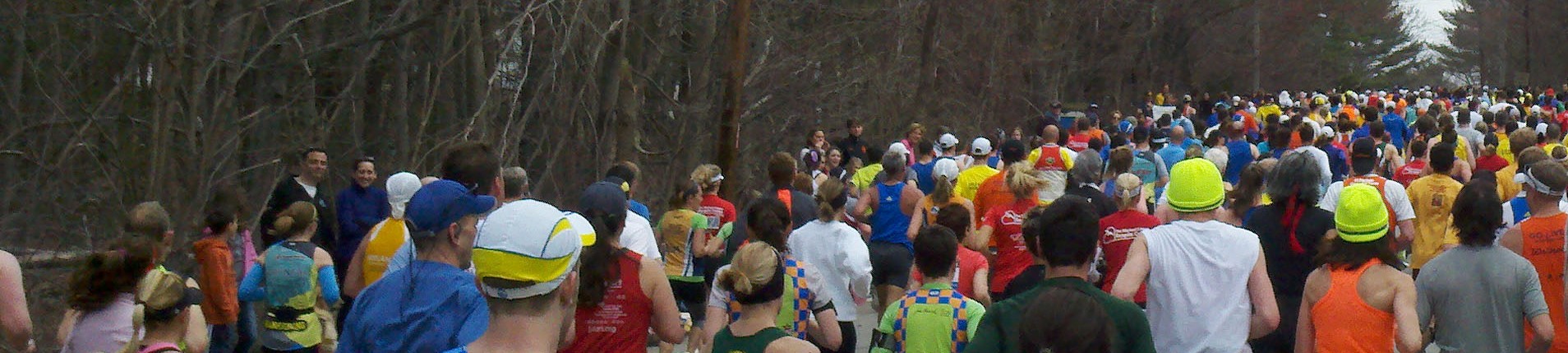
Along the way you stop a couple of times to take photos of the hoard – never brought your phone on a run before, but since this is the last one, and since it is the big time, it seemed like a good idea, and it lets you catch a photo of the sign for Framingham – where your father returned again and again for surgery after the war, which connects in your mind with the uniformed servicemen and women controlling traffic at many of the cross-streets.  There are a hundred little things like that to see and remember, but mostly it’s the continuous cheering crowd lining both sides of the route, with their signs and high-fives and kids reaching out for hand-slaps as you pass by, that make it feel like coming home, generating warmth not just from the rising sun or the sweat, but from the good will pouring out all around you.

Around 22 miles you look for Jennifer, on the corner the two of you picked out with Google Earth, and there she is, camera pointed. A quick hug, a hearty kiss, wisecracks from the people standing beside her, and you’re off again knowing now the goal is to spend these last few miles burning up whatever strength is left, to get the most out of this one last time and the pulsing humanity lining both sides of the course, now two and three deep.

The closer you get, the deeper the crowd is, and louder, voices bouncing of tall brick buildings, fueling you to think “it doesn’t get any better than this,” this glorious celebration and welcoming – four-hundred-thousand people, the press predicted – pouring out their goodest-good-vibrations for strangers and family alike, a festival of community as you make the final left onto Boylston and get your first glimpse of the finish three-and–a-half blocks away.  The emotion builds as you push still harder, breathing locomotive-loud with every footfall, heart beating like it wants out of your chest and your only goal is to drain out as much of yourself as you can, to be spent and exhausted at the end of this road, and then in an instant you’re across the line, legs stuttering to a stagger.  Someone hands a bottle of water as you try to stay upright and get some air into your lungs, then, another volunteer puts a plastic cape around your shoulders as she tells you to keep moving. Farther down the block, they hand you a medal to drape around your neck, and despite the fact that every limb is screaming with pain you begin to really feel the glow of triumph and self-satisfaction, to realize what a great day this is – one of the best days of your life – when  POOMF

Not Blam! or Bang! or any other comic-book-speech-bubble-sound, Not thunder or earthquake or ground moving beneath your feet, or even very loud, really.  Just ‘POOMF’, but a sound so out of place you know in an instant what it is, and when you turn you see down the block the back-side of the finish line arch, with dozens of people strung-out between here and there and every one of them turning just as you are, to stare at the column of white smoke rising from where, two minutes before, you passed the shoulder-crammed crowd of spectators.

‘Maybe a gas line burst,’ someone says hopefully, and you say no, that wasn’t a gas line, because you know – but of course you’re wrong: it wasn’t a vest and it wasn’t a belt.  It was a backpack-filled-with-pressure-cooker-filled-with-fireworks-nails-and-ball-bearings.

Which is also not a gas line.

Where’s Kathy?’ one runner cries out – or maybe it’s ‘Mary’ or ‘Judy;’ the name doesn’t mean anything to you but the point is crystal clear.   ‘She was behind me,’ answers another, and whether one of them says ‘Oh my god,’ or you just think it, the meaning is the same as in your head you do the quick math – Jennifer was at least three miles back of the line; however long it took you to run that, it’ll take her a lot longer to walk it, so there’s no way – unless she hopped a  bus or took the tube…. You pull out the phone – which you never take on runs but you did today because it was going to be the last one – and text her, just the letters: “I M O K R U”’, but the first time you check for a response, the networks have gone down and it will be hours before you receive or send another message.

There are no sirens yet, just a murmuring stream of runners, and the race workers urging you all to keep moving, their voices calm and gentle as if nothing at all has really happened.

You start walking again, dazed and confused, body starting to chill though you don’t quite notice it yet.  You’re farther down the block and it all seems kid of distant and unreal until POOMF -a second time, and this is when it truly hits home; in this moment everything else about this day seems suddenly small and silly and pointless, as you seek-out the nearest stable object and grab-on tight with both hands, the words clearly verbalized whether the syllables come out of your lips or not – “people are dying, right over there” – while your entire body starts to vibrate and the tears come, the first time.

By now the sirens have started, distant and inconsequential at first, like they could be any city street any time of the day or night, except they continue and multiply as you heed the volunteers’ instructions to keep moving away.  Moving away, under a darkening sky; sun hidden now, wind picking up; reminders of the morning’s cold; or the cold of midnight; the cold of things that end forever.

As cold as you soon become, focus is impossible; it’s half an hour before you remember the long-sleeved shirts tied round your waist miles ago and fumble them on, though they do not help at all as you arrive at the lamppost you and Jennifer had scouted for a rendezvous, to find her nowhere in sight.

It’s an hour from the moment – an hour of no cell service and no word from Jennifer, who you’re so sure was far from the scene, and yet so not-sure at all – an hour of listening to people trying to figure out what’s happening, the news so far all cryptic, half-conjecture – before she appears out of the chaos to find you shivering and blue-lipped, arms-wrapping and feet stomping to try to get warm, and seeing her face and feeling her hug is about as welcome as anything has ever been.

It’s maybe two days later, that someone asks – do you want to come back?

One more time,” you were thinking, waking up in that darkness. “One last time and you’ll never need to put yourself thru that again,” but now the answer comes in a heartbeat: “absolutely”.  To hear that crowd, to run that last hundred yards past where it all went down?  To stab a middle-finger in the eyes of the impotent losers who did this to all those beautiful smiling spectators? Damn right you’re coming back.

It’s maybe a month after the day that you realize you were wrong – about everything else being small and silly and pointless. When yet-another person asks you what it was like and you realize you don’t want to talk about the tragedy, because that gives the idiot bastards too much credit. What you want to remember and to tell about is the crowd that day, the outpouring of support and encouragement and what certainly felt like a kind of love.  About how it was really those spectators who were targeted, who paid the most in blood and sorrow, who deserve to be remembered, and they who make you want so badly to do it all again.

Which is why, six weeks after the day, you run again in another town, and find something has changed; despite it being as hard as ever, there’s a sense that this is now something you do, has become a part of you, though underneath the handshakes and smiles of the finish line you feel the emotion bubbling up from the deepest places inside, and sneak off into a nearby alley to huddle in a doorway as the tears return; not for the last time.

At  five months after, you apply to go back, only to learn that so many people want to run that first-year-after – so many people want to thumb their noses at the fiends and all their like – that you don’t quite make the cut-off.

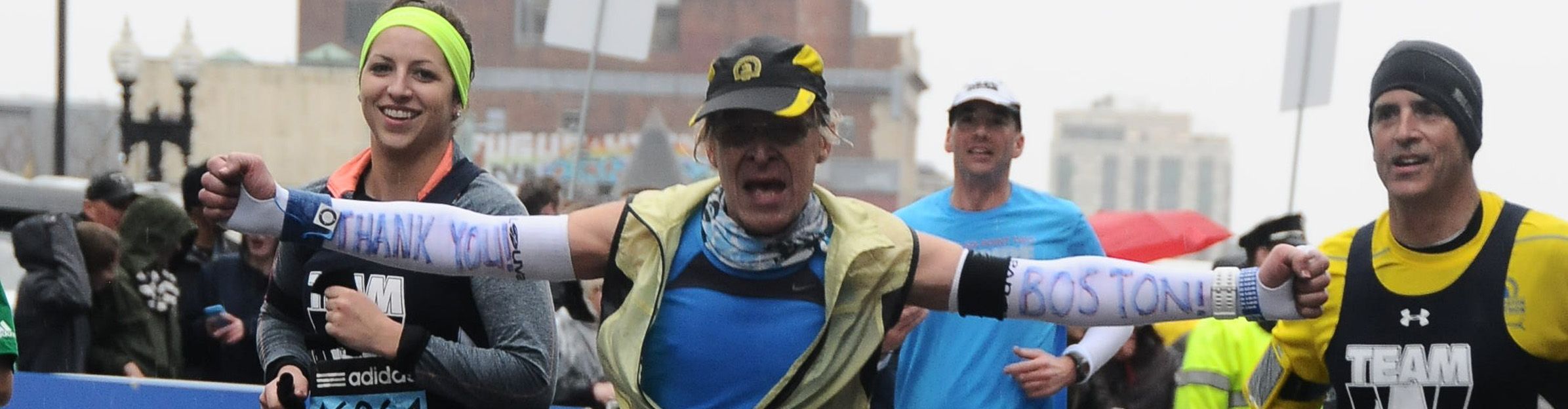
And so you suck it up and train harder and run more, and now – a month from today; two years and five days after that moment,– you’re gonna get to go back and do it again. Travel those same roads and tour those towns and campuses; turn that same final corner feeling the warmth of that mass of humanity and shout ‘THANK YOU’’ and ‘BACK-AT-YA’ to them, for being there, year after year – though no one ever gets a medal for spectating. To honor and to thank them for coming out again to welcome thousands of strangers into their city –

ONE MORE TIME