Where Men Win Glory, Jon Krakauer

Journalism at its best, as Krakauer rescues a worthy role model from the politically-motivated banality to which the mass media reduced him. His telling makes one feel the loss of Pat Tillman – and the Defense Department’s subsequent cover-up of the fact it was friendly-fire that killed him – as a visceral, personal tragedy. His extensive attributions and quotations of the perpetrators’ self-justifications convincingly assure that this is not a hatchet job. What it is, is one more example of the random wastage of a nation’s greatest resource, with no point or benefit in the instance, whatever one’s opinion of the validity of the cause which has been proclaimed.

Especially poignant is Krakauer’s treatment of the moment of Tillman’s death – a passage which cannot be read without pausing for tears and an acknowledgment of the ubiquity of death and injustice. Equally moving is the plight of Marie Tillman, Pat’s widow, who seems condemned to live on, knowing how unlikely it is she can ever match the heights of love and joy she shared with Pat.

Painfully-effective storytelling, and a service to both the protagonists and the wider community.

The Warm-up Factor

Ever lace up your shoes and head out the door, only to have that the first mile blow you away with how easy and natural it feels, then look down to find a fabulously fast time on your watch at the end of it?

Neither have I.

In fact, I usually feel like the first part of every run is a total slog, calling into question whether I have any business being out there; if I shouldn’t just pack it in and head for the couch. Other runners I’ve talked to say the same thing.

Run with a GPS though, set to show current pace, and you may be able to watch what’s happening. Going out strong, that first mile pace is likely a full minute (or two) slower than your brain says it ‘should be.’ Get distracted by the traffic, the scenery, music or thoughts, and the next mile comes up faster, with the same perceived effort, and the next one may be quicker still.

More than reading any articles or books, observing those times has proven to me that there really is such a thing as warming-up – that first few minutes (or at my age, fifteen!) when the body is shifting gears, re-allocating resources and getting its bio-chemical support systems up to full operation. Getting on a treadmill with a heart rate monitor tells a similar story – for the first few minutes my heart rate seems way higher than it should be, even at a moderate pace, then gradually settles down. Halfway thru the workout, I find myself running a faster pace at a lower heart rate – and with less perceived effort.

Recognizing this can play into strategy for events. For short distances, make sure you are thoroughly warmed-up before the start. That’ll make every measured mile count in your favor, and since it’s a short event, you don’t have to worry about your warm-up draining energy reserves enough that it might hurt overall performance.

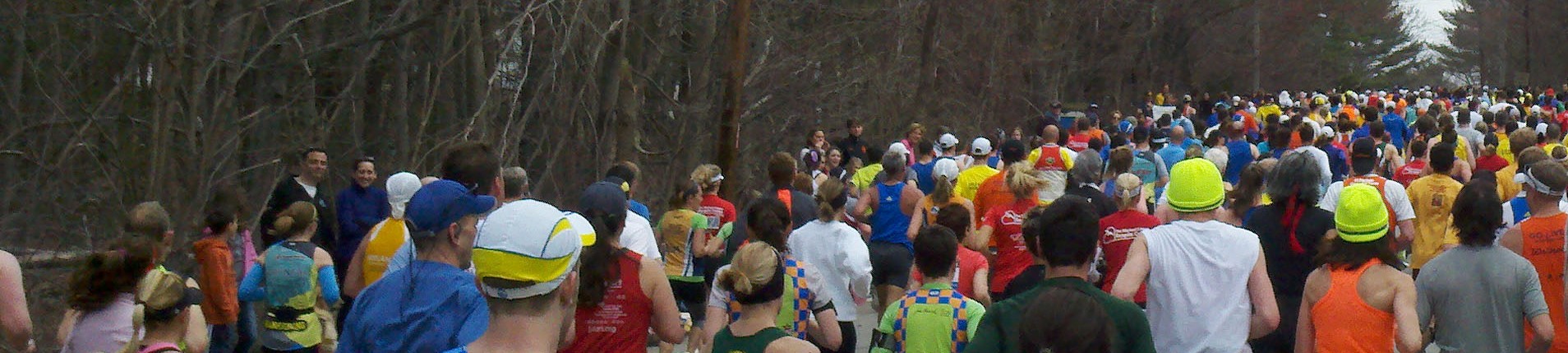
For a longer event, where stamina is the key and a slow start can get evened out over many miles, you may choose only a minimal warm-up, and let the rest happen in the first part of the event, conserving your body’s reserves for the long haul. That’s especially true in mass starts, where you’re going to be held back by the crowd anyway, so you may as well let that initial ‘Times Square Shuffle’ be your intro.

Any way you play it though, recognizing the Warm-up Factor can help reduce that ‘what was I thinking?!?’ reflex to a minimum.

Is this a pain, or what?

A very important person in my life likes to say, “if it hurts… don’t do it!”

As a runner I respond, “well, yeah, but…”

Truth is, if you’re at all interested in running, you’ve probably heard or read comments like “running to your full potential requires a high tolerance for pain…,” and even those of us in the middle of the pack – who may not be hell-bent on pushing our limits – have to expect some level of unpleasant sensations. Heat and sweat, hunger and thirst, sore tired muscles, rubbing and blistering, they all come with the territory, but are they really ‘pain’?

My battered old paperback Webster’s defines ‘pain’ as “physical or mental suffering…” and I’ll admit that sounds a lot like how running sometimes feels. Fortunately, the good Dr. Daniel W. goes on to say “… caused by injury, disease, grief, anxiety, etc.,”   Now we’re talking! ‘Pain’ is that category of suffering which is caused by some sort of negative influence; ergo – I love using that word; it sounds like the name of the robot dog in some sci-fi carton series, doesn’t it? – ergo: the category of suffering caused by something which is not negative or destructive, is not ‘pain.’ (It’s just ‘suffering,’ as if that is any better, right?)

Well, actually, this MPR does find it is better, especially if you take it one step further and consider that suffering is not all that different from ‘being uncomfortable.’ If I am suffering because I’m pursuing something I love and enjoy (even if I enjoy it most when I finally stop, having achieved my goal for the day…), then I’m not in pain, I’m just uncomfortable, and you don’t have to be a Navy Seal to know that life isn’t supposed to always be ‘comfortable.”   (You just have to have a few Scottish-Presbyterian ancestors – or Eastern-European, or African-American, Jewish, Korean, or any other nationality or ethnicity that had to work and struggle for survival or to establish themselves in a new strange land – which is all of them).

So when the going gets tough and the right side of your brain says “I’m in pain,” use the left side to drill down thru the sensations and figure out just what is causing them. If you can tell that something is doing damage, will potentially cause you not to be able to run tomorrow or the next day, then by all means, pull over and take care of yourself. But if the answer is no, I’m not doing damage, I’m just sore – or tired or hot or hungry or (fill in the blank) – put it in the box labeled ‘uncomfortable,’ do what you can to get more comfortable (take a drink, eat a gel, vary your stride, strip off layer…) and get on with the laudable objective of proving yourself ‘Too Stubborn To Stop.’
Why Not To Be Lead Dog

If you read this blog, you’ll know by now that I have never actually led a running event, but I have run some very small events, and one of those taught me a lesson about being ‘leader of the pack.’

The Grand Valley Marathon (Palisade, Colorado, is wonderful, but tiny. In fact, one year I ran it, there were a total of twenty-seven finishers. Even considering there were a few more folks who DNF’d, spreading that few people across 26.2 miles means a lot of empty course and so, for several miles of this out-and-back, I got to experience a bit of what a Lead Dog must feel – nothing but open course from my nose to the finish line – and I have to admit I was enjoying the fantasy.

My big lesson came at mile 23 though, when the road we’d been following forever (at least it seemed like forever at that point) reached an intersection and for the life of me I could neither find a race sign nor remember with any certainty which way we’d entered this same intersection twenty miles before. Fortunately (I thought) the road heading off to the left rose up onto a bridge across the Colorado River, giving me a clue: starting about mile 2, we had followed the river’s bank for a mile or more, so I picked up my stride and headed down the road that seemed destined to hug the river, only to find myself, several minutes later, in a neighborhood I was sure I had never seen before.

You can guess the rest – I’d picked the wrong road, and by the time I was certain of that, I’d gone half a mile off course. And by the time I’d stood around being angry with myself, despaired at what this would do to my hoped-for finishing time, actually quit and started to walk back to my car before my left brain finally convinced my exhausted right brain that the morning would be better spent if I finished disappointingly-late than not at all – and made my way back to the intersection, where I immediately observed another runner not making the same mistake – I’d eaten up a good fifteen minutes. All because I’d been out there with no one ahead of me!

Not getting lost – one more way in which the view can be just grand, when you’re not Lead Dog!

GPS Will Free You

One of the things I love about running is it simplicity – no deraileurs to adjust, no flats to repair by the side of the road in a chill drizzle – and the freedom to go nearly anywhere – pavement or trails, rural or urban, crowded sidewalk or lonesome nowhere. So it may not be surprising that I put off for a long time any thought of using a GPS. From the early handhelds to the initial wristwatch styles – comically oversized even on a big man’s wrist, which I do not have – they seemed like one more way to make our sport expensive, complicated and regimented.

At the same time, I accepted without thinking that I must limit serious training runs to half a dozen routes around home which I had been able to drive or measure on a topo map, so that I knew the distance accurately and could compute my time and pace. Runs in unfamiliar locations, while fun and rewarding, were pretty much just for maintenance, since I had no way of knowing how far I’d gone. Yeah, you can use Google Earth and map a route and get a distance, but it’s pretty cumbersome and not all that accurate unless you zoom way in to follow each twist and turn, not likely when you land in a new city and want to explore its neighborhoods and parks while maintaining the build-up to that next event.

Which is why I did eventually succumb, and discovered that running with a GPS actually grants me the freedom to run anywhere, and still keep track of it.

Not only can I go out to explore a new city, but even here at home, I no longer have to stick to established routes. Want to detour and add a hill?  No problem. Want to detour and avoid a hill? No problem. Feel like exploring that neighborhood I’ve run past a score of times but never ventured into? No Problem!

With GPS you can wander to your heart’s content and not only know how far you’ve gone today, but store that info away as a possible objective for the future. Where previously I’d felt limited to a few pre-measured routes, now every road, path or trail is a potential training route.

Just goes to show, you can teach an old dog a new trick, it just takes a little longer – and GPS will be happy to tell you just how long.

Nike + Sportwatch

One of the great things about running is the low entry cost – even a really good pair of shoes cost nothing compared to a decent road-bike. Maybe that’s why I waited years before trying out a GPS – that and the clunky look of early GPS watches – like something Darth Vader would strap to your wrist so he could monitor your actions and deactivate you if you misbehaved.

The Nike+ Sportwatch caught my eye for its (relatively) sleek styling, decent price (again, all things are relative), and claims of simple operation, which turn out to be true. One touch of a button sets it searching for satellites, and once it has connected with them, just one more touch starts it timing and tracking. One final touch at the end of a run and your route, time, distance, elevation and pace are all recorded, to be downloaded automatically when plugged into a USB port with internet access.

Nike +

You can interact more if you wish – scrolling thru functions is easy enough even with sweaty or gloved fingers – but you may not have to, since you get to choose which function is displayed in extra-large easy-to–read numerals (I like to see my pace, a moment-by-moment coach which has turned out to be very instructive), plus a second in smaller numerals.

https://secure-nikeplus.nike.com/plus/products/sport_watch/

I haven’t tried any other GPS watches to compare, but then again, I haven’t felt any desire to. My Nike+ is a faithful tool and I never run without it!


Quibbles to be aware of: I find the pace displayed while I’m running is often faster than what shows up in the permanent record on the website. Perhaps there is some accuracy-correction going on in the home-ware, but it’s disappointing to see a 6:06 pace on your wrist (cruising down a very steep hill mind you….) and then find the recorded profile shows you were really barely breaking 7 minutes. Elevation can be similarly squirrely, with one beachfront-run registering 95 ft above sea level when I could hardly credit 40’, given I was in sight of the waves across a hundred yards of not very steep sand.

The website is a bit cryptic in its instructions, but I’ve found Nike’s technical assistance very helpful.

Be aware also, that if you let the rechargeable battery go to zero, the watch will re-set to some years-ago date when charged-up again. If you don’t re-set the time and date before your next run, it will get recorded in 2005 or something. All is not lost though, you can e-mail tech. service and they will put you back into the present day.

Any Human Heart, William Boyd

What a Find!

I picked this up at the informal lending-library outside a local liquor store, just on the strength of the back-cover blurb, and it turns out to be one of my most satisfying reads in years. A sort of super-literate anglophile Forrest Gump, this is neither more nor less than the story of one life, well-lived and equally well-told.

While the central conceit – a bundling up of episodes & intermittent journals – at first sounds limiting, it actually frees the author to tell only the parts of Logan Mountstuart’s life he chooses, and to insert ‘editorial’ exposition where needed to bridge the gaps of time or detail. At the same time, the first person voice of a protagonist who is credibly both educated and introspective gives access to thoughts and emotions without seeming fake or forced. The upshot is that this reader experienced Logan’s ups and downs quite personally, especially the decades-later mourning of his second wife and daughter, random victims of the London Blitz.

In my book, Boyd is a writer to seek out, up there with Ann Patchett and Michael Cunningham – smart, generous, entertaining and meaningful.


Again, this is a find.

I-Pod Shuffle

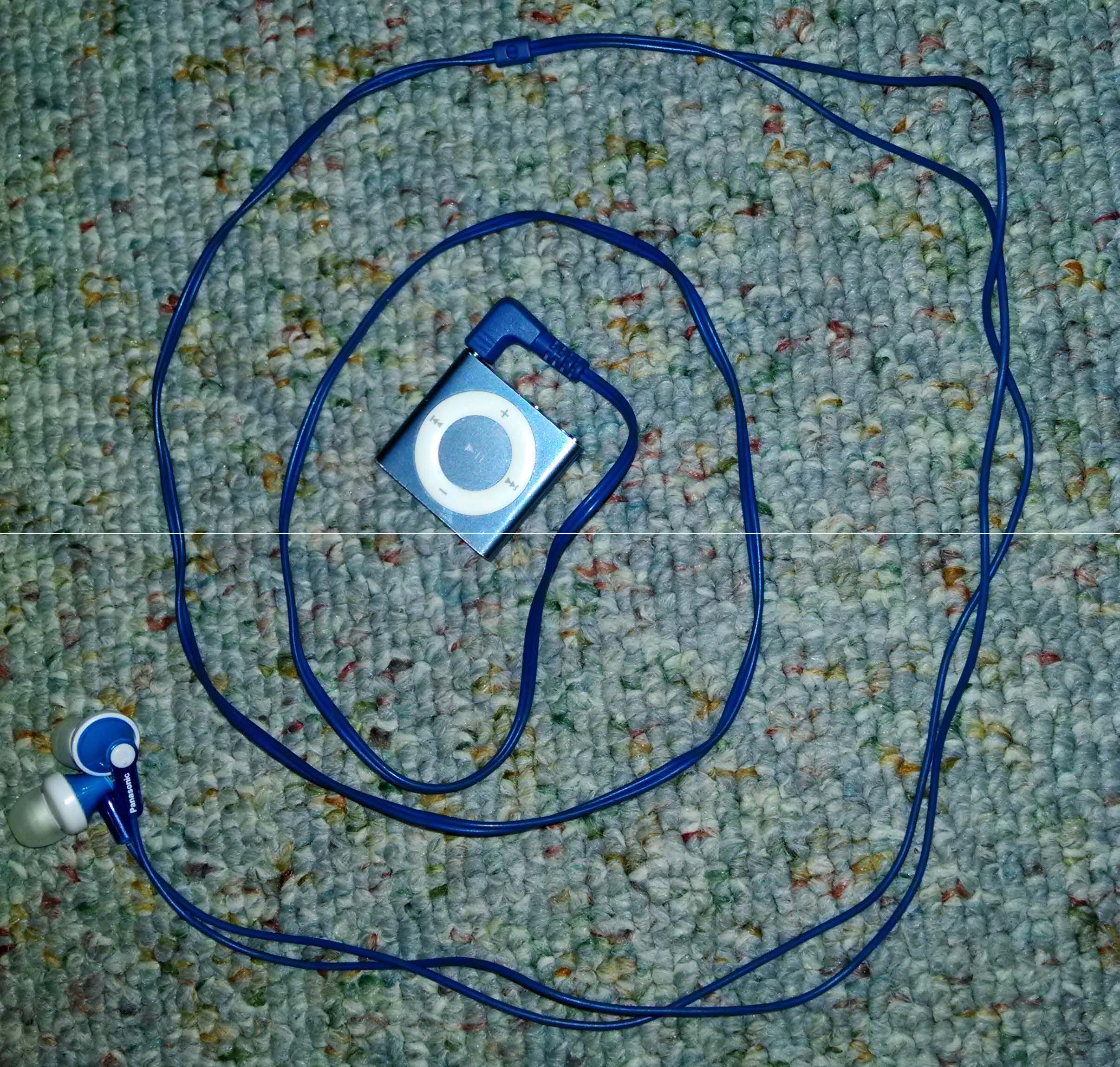
One thing that really works for this MPR, is Apple’s I-Pod Shuffle. Tiny and practically weightless, it livens up long runs with an absolute minimum of complication.

I wear mine clipped onto a terry-cloth wristband (which is there primarily to blot up whatever needs blotting up as the miles accumulate). That lets me raise it up in front of my face when I want to adjust the volume or skip a song, but keeps it out of the way the other 99.9% of the time.

The original ear buds never felt right in my ears, so I use a pair of inexpensive Panasonic’s I found at a discount store, that stay in place through anything, and have the additional benefit of being a cool blue color.

I Pod Shuffle 1

Run the headphone cord up your arm – under the innermost layer of clothing so it stays put during the after-warm-up strip-down – then out the collar, and you’ve got a no-fuss mini-sound system that turns any run into the staircase scene from Rocky.

http://www.apple.com/ipod-shuffle/