Category Archives: Running

Faster Is Not Necessarily Better

So you’re maybe feeling confident about going the distance, in pretty good shape for the person you are, but as an MPR, there are an awful lot of folks finishing ahead of you – some of them your friends, some of them older, some pretty casual about training, and some of them rank-beginners apparently possessed of a natural ability to cruise blissfully by as you’re huffing and aching…  Wouldn’t it be great if you could pick up the pace some more, cut those times?

Speediness envy is lurking out there, searching for chance to corrupt your mind and body.

Well OK, it’s not exactly The Last Temptation, but as I sit out another weekend of severely-limited exercise, I’m forced to consider – is trying to get faster worth risking an injury?

(Quick replay: to build speed in the weeks before a much-anticipated event, I added a mid-week interval workout, and amped up the calisthenics (lunges, steps, planks, etc.)  on non-running days.  A big long-run ten days ago went well, with just a slight soreness in one hamstring.  Couple days later, calisthenics OK, but definitely working the muscle-groups hard; a healthy soreness afterward. Next day, an interval workout on the treadmill (which happened to include breaking-in a new and supposedly-faster shoe), also went well, though that hamstring started complaining toward the end. Next morning? Could barely walk for the bowstring-tight screaming cable in the back of my left leg.  Rest for two days and head out on a gorgeous sunny morning? Couldn’t jog a hundred yards!)

Two lessons I’m going to try to learn from this:

Number one – Blame the new shoes!  Juuust kiddingggg; actually, since I tried them right after starting the new calisthenics and at the same time I was peaking mileage and pushing the pace in intervals, there’s no way to tell which of four different factors led to the injury.

Note to self: change one thing at a time to isolate the effect – and give it enough time to play out for good or bad before trying something else.  Otherwise you’ll never know what made the difference.  And knowing that will make all the difference, as recovery tapers into resumption.

Number Two – Ten days of reduced activity and I’m pining for the endorphins, the unique warmth-from-within generated by muscles converting glucose into movement, the satisfaction of having completed a good workout.  Right now I’d gladly tack some seconds onto my pace, just to have a pace!

So, a new addition to the list of MPR credos: it’s better to run less fast, than not to run at all!

A More Detailed Game Plan

Running-writing is filled with things to do – tempo runs, long slow runs, intervals and fartlek; train for speed, train for strength, train for endurance; hydrate  – but don’t over-hydrate or you’ll get hyponatremia! Take in this many calories based on your body weight – but be careful what you ingest and how much, so it doesn’t upset your stomach.  Shorten your stride or increase your cadence, land on the mid-foot or the forefoot or underneath your body; make sure you…

How can anyone keep track of all that in the middle of a jostling crowd or a twisting, turning trail?

Regular training that builds-up a base of experience is a big part of managing all this information. Consciously trying out something in a training run, then next time varying it – or doing the opposite – is the best way to figure out what works for you.

Event day, though, is no time to be trying things out; which is why we need a game plan – a clearly-formulated idea of how you intend to run that particular event.  A recent big event reminded this MPR of the need to make that game plan more detailed:

Going in, I had a specific target time in mind, and trained for that pace at that distance.  Knowing nutrition would be a big part of making my goal, I planned, tested, and prepared a belt with two bottles of energy gels, slightly-diluted so they’d go down more easily in the brain-dead later miles.  I’d carbo-loaded for two days (not overeating; just moderate amounts of food but with a higher percentage of carbs than normal training diet, like the articles said)  Race day, and the first half went great: on pace, never feeling depleted, but a couple of miles later came the dreaded ‘bonk.’  Pull out the fuel bottle, take some in – no effect.  Grab something to eat at an aid station and it felt marginally better for a little while, then ‘bonk’ again.  And because it was late in the race and the ‘bonk’ had already hit, it was a struggle to force anything down – nothing seemed palatable, even though I knew I was in desperate need of calories!  Perfect recipe for a disappointing day.

The problem?  I’d planned my fuel source, but not when to take it in.  Training runs since then have been experiments in fueling early, before it feels necessary.  That seems to work, so next event, I’m scheduled to take in a gel (or equal) at the start, and another one every two miles, whether it feels like I need it yet, or not.

Same thing can apply to hydration – if a run has aid stations every two miles, you might schedule yourself to drink a cup of water at one station and electrolyte at the next, alternating the whole way.  If the aid stations are farther apart or you know you need more fluid, you might plan to drink two cups at each one.  If you’re running a long distance for the first time, you might plan to walk a hundred yards while you drink at each station to give your body a chance to relax back into form.  Or do that every two miles by the markers, or…

Just don’t leave it to ‘what feels right at the time.’

Don’t know about anyone else, but my brain simply doesn’t work as well during an event. Adrenalin, distraction, fatigue and excitement can all cloud one’s judgment, so the more we plan it out and give ourselves one or two simple rules for the day, the better odds of having it end the way we’d hoped.

Having a game plan, and making it as specific as you can, will increase your probability of a successful event!

(At least, that’s the plan…).

Run for Your Life – But Don’t Count On It

  There is a time for being ahead, a time for being behind; a time for being in motion, a time for being at rest, a time for being vigorous, a time for being exhausted;*

 There’s a small lake near my home, with a ¾ mile paved path around it – perfect for tempo training – and overlooking that path is the home of a woman with the long, lean sort of build you might well pick out of a crowd as a being a natural-born runner, who sometimes waves or shouts encouragement as I go tootling by. She did in fact run competitively from high school thru early-middle age, though no more; her hips; she says, just cannot take the pounding…

One reason I’m still able to run may be that I started quite late in life, encouraged by a good friend who’d been running shorter distances for decades, and wanted to step up to a hemithon.  We trained and finished that event almost a dozen years ago, and several more together, till he ran up against a string of injuries. Now, after his only-semi-successful knee surgery and therapy, we find other thing to do together, besides running…

And then there are those moments sitting at the desk or on an airplane when you move your feet and feel a twinge on the inside of one knee.  Or the first steps of a run, where one ankle seems about to crack, so you vary your stride and hope it goes away once things get warmed-up a bit.  The hip feeling ‘wonky’ as you walk down the stairs for morning coffee.   The trail-running tumble last summer that initially seemed like just another case of road rash, but now you’re wondering if that shoulder is ever again going to have the same range of motion as the other one…

The possibilities, unfortunately, are endless, and so, on this cold and damp and grey morning-of-the-tired-legs, when I can readily come up with multiple excuses not to get out there again, my better-self reminds me to:

Run like you’ve been running all your life; it’s natural it’s healthy; it’s one of the things our bodies evolved to do;

  • Run like you will be running all your life;
  • But don’t ever take it for granted –
  • Don’t ever count-on being able to do it forever, because you know that an injury could end your career at any time,
  • And, as a direct consequence of that knowledge: make the best of every day on which you can get out there and pull one foot off the ground before the other one touches down.
  • Be all the more grateful for knowing how precarious that gift is.

Run for your life!

(* Stanza 29, Tao te Ching, A New English Version, by Lao-Tzu as translated by Stephen Mitchell, Harper & Row, 1988)

Run-up to Boston – Part 5 – That Crowd!

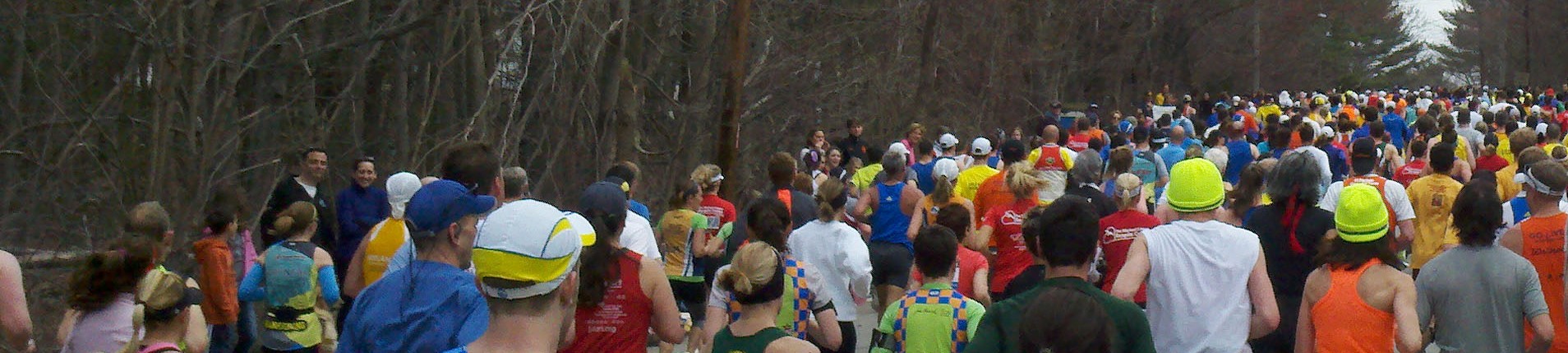
I’d read about it before my first trip to Boston, but nothing in print prepares one for the reality, which includes:

Homeowners and compatriots hooting and encouraging from their front lawns as you leave the holding area at a Hopkinton school yard to walk the half-mile or so to the actual starting corrals.

Friends and family six-deep and more at the start, snapping shots of loved ones as they finally find enough open pavement to break into a run, bursting with energy pent-up thru several hours of waiting, queuing and standing shoulder-to-shoulder.

Barely as much as twenty feet of unoccupied curb on either side for the entire distance.  (Except one thinly-wooded stretch early-on, where lots of male runners were stopping relieve themselves, barely off the route and not at all concealed – come on guys!)

Service-women and -men in uniform controlling traffic at many of the side street intersections along the way; a great honor to be so cared-for by you.

The colleges: yes, there are hundreds of college students in Wellesley and Boston College, generously offering the kind of hysterical enthusiasm that comes from being cooped up on small campuses with large expectations.  Much appreciated!

Signs – some clearly aimed at a particular runner, but tons offering non-specific encouragement, with the result that even an out-of-towner feels like they are running thru family and friends the whole time, making this feel like a home-town event, no matter where one hails from.

The volume!  You want to plug-in for extra encouragement thru the late-teen miles? Fugeddabout it!  Not only is it impossible to hear over the crowd without cranking-up to a head-splitting level; it quickly becomes clear that not even Born To Be Wild is as effective a spur as all those voices and faces!  Plug-out and observe; this is priceless

Crescendo – by mile 22 or so, the bigger buildings are closing-in, the crowds even thicker and the volume just continues to grow, equally-heartening whether you are struggling to hang on or ready to start squandering some hard-won hoarded reserve for a strong finish.

Rounding the turn onto Herford street it seems like it can’t get any better (visions of Olympic rings and Super Bowl trophies may come to mind, as you picture your own private ‘Miracle on Ice’), until that final left onto Boylston kicks you in the shorts even more.  How can you not give your all to these people who fill the sidewalks, standing in the cold, or rain, or baking sun, beaming their own personal energy and emotions out to supplement whatever you have left?

Which brings up a somber thought: none of the reporting I’ve seen about the tragedy of 2013 has sufficiently emphasized that the bombs were placed not on the course, but in the midst of the spectators at the finish.  The majority of those injured that day – and all of those killed – were not runners at all, but people who had come to cheer them on. People who would get no medals that day, would have no finishing-time to put in their logbooks; who were only there to encourage others.

And the next year, the crowd was bigger than ever!

Running a marathon is in many ways a selfish pursuit; spectating at one is just the opposite; an act of generosity and even love.

SO THANK YOU BOSTON CROWD, YOU ARE WINNERS, EVERY ONE! 

In Control of Your Goal

In soccer, one goal is a big deal; in basketball…not so much.

In running, goals are not the be-all and end-all as they are in ball-sports, but they’re very useful motivators.  Over time I’ve come to believe that three goals is the perfect number for an MPR to consider for any event.

Goal Number One is what you have been training for and realistically believe you have a good shot at making. It may be modest or ambitious, but it is generally quite pragmatic and objective, like:

To complete a distance longer than you’ve done before

To finish under a certain time

A new PR, even if by seconds

A new PR, at a specific time or pace


Goal Number Two is the dream – not only making your Number One, but even surpassing it.  We don’t hit this one very often, but when we do, it can be a lifetime memory.

PR by some significant margin

To place in your division

To complete a distance that used to be a struggle, and do so with the feeling that you own it; that from now on it’s no longer ‘can I do it?”, but ‘how well can I do it?’


Goal Number Three is the fall-back:  if  things go wrong, and you see goal Number One slipping out of reach (and goal Number Two starts to feel like a cruel tease you’ve played upon yourself), having (or improvising) a strategy to salvage the day can be a crucial motivator.  This is also where the MPR attitude comes into play: we are not out to ‘win.’ We are not out to beat any other person. We are out to demonstrate something of ourselves to ourselves, and to experience the experience.  With that in mind, Goal Number Three might be:

To match the time you had in a similarly rough run last year

To at least be under XX time; some significant-sounding roundish-number which is short of your original goal, but seems do-able in the thick of today (‘recalibrating’ your goal)

If you’re on a new or more challenging course or distance, then just to complete it

If you’re on a distance or course you’ve struggled with before, then to finish without it feeling as much of a struggle – even if your time is not  what you had hoped (note: this is a very worthwhile goal, and too often ignored in the push for a specific time)

To keep a certain pace for at least part of the course

To ace one part the course – a strenuous uphill, a technical downhill – even if the rest of the day is not so great

To have enough juice left to make a push in the final half-mile (or hundred yards, or fifty, or ten!)

To still be running at the finish line (there are days….)

Simply to finish the distance without injury, ready to go back out and train some more for another day (again, a very worthwhile goal).  For an MPR with eyes open to the big ol’ world out there, any day we can run, is a good day!


What is important about an Goal is that it be meaningful to you; that it reflects why you – individually and uniquely, you – are running at all.  Something you can choose and achieve(or not) regardless of how well others may do that day.

Which is where MPRs differ the most from Lead Dogs: a Lead Dog’s success is highly dependent on how the other dogs do.  MPRs are in control of our goal(s), and that is a grand place to be! 

Run-up to Boston – Part 4 – Why Bother?

Run-up to Boston – Part 4 – Why Bother?

One thing – maybe the thing – that makes Boston different from nearly all other marathons, is the qualifying requirement.  Where other events welcome all comers, and manage their numbers – if necessary – via lottery or ridiculously fast sell-out, Boston is unabashedly elitist, using its multi-tier registration process to ensure it admits only the fastest of those who apply each year, which pretty much guarantees that MPRs who make the cut at all will start and finish at the back of the field.  Yup; a person used to finishing in the middle of the pack at other events, could well find herself a ‘squeaker’ here, lining up in the last wave wearing bib number 26,236 out of 28,000 and, thanks to the multiple waves with multiple corrals in each, finishing hours after the big names have received their awards and headed for the showers.  On top of that, it’s expensive to travel and stay in Boston, an hours-long cattle-call getting to the starting line (which temporarily consumes the tiny town of Hopkinton like a nebula-cloud enveloping the Starship Enterprise), almost impossible to find friends at the finish, and requires seven to 14 months of forethought and planning.  So why bother?  Well, there’s…

Bragging rights – to a lot of your family, friends and people you meet now or in the future, the Boston Marathon may well be the only running event they know by name (except perhaps the Olympics, which is even more difficult to get to).  Civilians who know nothing else about this sport (pastime? addiction? religion? – whatever it is to you) will know that running this one is a landmark, so being able to say, with utmost casualness, ‘yeah, I’ve done Boston’ is one of the most satisfying ways to reassure yourself that you actually are ‘A Runner.’

Schwag – the BAA folks, who put on this event – have great taste. Their unicorn logo is cool in an ‘old-patrician-establishment meets new-age-mysticism’ sort of a way, and pulling out your participant shirt is always reassuring after a disappointing workout.  I have to admit though, to being of two minds about the jacket – seeing someone show up at a 5K wearing one engenders an odd mixture of respect with disdain – ‘you ran Boston – you must be good’ is immediately followed by ‘but what are you trying to say by flashing that here,’ which flows all too quickly into ‘are you gonna’ be good enough today to justify that flash?’  On the other hand, it’s a great way to connect with others who have shared that same experience. I manage my jaundiced attitude by wearing a t-shirt, logo-cap or visor – recognizable to those in the know, but less flashy than a bright yellow jacket with ‘BOSTON’ plastered across it.  Yeah, I didn’t buy the jacket ‘cause I didn’t need to go around ‘showing it off’ – but now I wish I had.

Ego – those jacket-musings point up the mixed emotion this MPR feels.  Is wanting to run Boston a grand aspiration that helps you ‘be all that you can be’ or is it evidence of an unenlightened ego with something to prove?  My current platform position – subject to change as the election cycle progresses – is that it’s all of the above and more, in which vein I take some solace from stanza 68 of the Tao te Ching –

“The best athlete wants his opponent at his best….

All of them embody the virtue of non-competition.

Not that they don’t love to compete,

but they do it in the spirit of play…

and in harmony with the Tao.”*

That’s an attitude I am happy to admit – we MPRs go to Hopkinton for the joy of measuring ourselves against its yardstick – not to prove how good we are, but that we have done our best.

(we also go for THE CROWD – but that’s a story for another day…)

*Credit: Tao te Ching, A New English Version, translated by Stephen Mitchell, Harper & Row, 1988.

I N A T O P – I A W Y C D -T

What is that, some Welsh tourist attraction?  Nope, it’s one of my running mantras, origin as follows:

This past summer I took part in a backcountry race which I was fully-aware would be – for me – downright grueling.  I’d run the same event two years before, finishing long-after the time for which I’d hoped; exhausted, lame, doubled-over sick, and emotionally wrecked.  And even though this year I had a better idea what to anticipate, and had trained assiduously for the series of long climbs, almost from the start it seemed my view was nothing but butts disappearing into the distance.  The one-third point found me watching two runners who, when they first came up from behind had looked like folks I should be able to hang with, but were now steadily pulling away, and as we neared the end of a quarter-mile-long open meadow I looked the other way to see – not a soul visible behind me.

As I watched those two runners disappear without apparent effort into the woods – where I knew another climb awaited – discouragement settled in like a thirty-pound pack.  What was the point, an inner voice asked, if I was feeling this depleted this early, and every other runner was handling the terrain better than I?  Was I really going to be the last person to finish?

What salvaged that day was, in retrospect, nothing more or less than experience; having run enough events by now for another inner voice to pop-up and remind the first one that ‘how you feel in the middle of an effort is not necessary indicative of how you will feel at the end.’  (“Of course not – you usually feel much worse at the end!  – that’s not really true, but I just had to say it, because I know a lot of runners will be thinking it…)

Enough events too, that conditioning and habit kept my feet moving while those and other thoughts got processed, by which time I was into the woods, cresting that next climb and headed for a magical stretch of gently-undulating single track through forest straight out of Lord of the Rings.  It was in those woods I remembered someone writing or saying, ‘it’s not about the other guy,’ and realized how especially true that sentiment is for a mid-pack (or rear-pack, as the day may have it) runner.

Lead-Dogs are there to fight it out, agonizing over who is ahead of who (whom?), but we MPRs are in the game for other reasons; to find out what each of us is capable of, on a given course, on a given day, which puts it all in a whole different light.  Everyone pulling away from me?  Wish them well. No one behind me? Less pressure!  It’s a beautiful day, a wonderful trail, a blessing to be able to run – period – and me doing my best is not dependant on how well or poorly anyone else is doing.

‘It’s not about the other guy,’ struck a chord, and began repeating in my head (though I quickly substituted ‘person’), but this was a long run, and pretty quickly that simple mantra become elaborated into:

It’s not about the other person

It’s about what you can do

Today

Repeating those words over and over again pushed discouragement out of mind, and when it threatened to return I switched over to figuring out the anagram –  I-N-A-T-O-P, I-A-W-Y-C-D, T – and figuring out a way to pronounce it (no, I’m not even going to try writing that out phonetically).  Those games distracted the left brain long enough to get me to the next aid station, where encouraging volunteers (THANK YOU!), a PBJ and the sight of other runners started to turn things in a better direction.  There were plenty of slow stretches still to come that summer day, but that early one proved the worst, as focusing on the right objective put the rest into perspective. I really did feel better at the finish this year, smiling – able to stand upright – and with plenty of room to improve next year.

So keep on running, MPRs; for yourself, for your own reasons.   Every run is more experience under your belt; more proof that –

I N A T O P

I A W Y C D

T

however you pronounce it.

Run-up to Boston – Part 3

So, OK – you’ve made your BQ, sent in your registration, received the very nice notice they send out and posted it somewhere you cannot possibly miss seeing upon waking up every day. Now what?

First of all, it’s a wait. With registrations confirmed in September or early October and the run in mid-late-April, that’s up to seven months to anticipate. Seven months is 28 weeks give or take, and there are plenty of 20- or 16-wk. marathon training plans out there, so lots of latitude building your own schedule to arrive fully-prepared.  Set a plan and follow it; ‘nuff said.

Second – Boston is a big city, but close-in, affordable (everything is relative) accommodations fill-up early for race weekend, so find a place to stay as soon as you’re confirmed.  The event website has great info on travel arrangements and my experience is they are decent deals, so check them out and get something booked soon.

Plan other activities.  The race is held on Patriot’s Day, for goodness sake, and Beantown (beware, no one from or in Boston ever calls it that) has tons of U.S. history.  Touring the Old North Church or Paul Revere’s house takes on extra meaning when you’re in town to participate in one of its best-known events, and you’re sure to see other runners (recognizable by their jackets, shirts, caps etc. from the current or past years). For one or two days before and after the running it feels like the entire town is dedicated to marathoners, so plan time to soak it up – this weekend is a good as it gets for the sweat-soaked, black-toenailed crowd (and unless you tell them, no one knows or cares where in the pack you will start or finish).

Shop the gear – maybe I’m a dork, but it really fuels me to have a cap or shirt even before getting to the expo, plus it helps us loonies recognize one another.  Beware though, I’ve found the official Addidas shirts and shorts are proportioned for storks, giraffes, super-models and stick figures.  If you’re the least bit teapot-shaped (‘short and stout’) like me, they may not work all that well…

Tell people!  Many MPRs are kinda shy about their achievements – I mean we are the folks who bust our butts, consume our mornings, evenings, lunch breaks and weekends, spend our money and baffle our families – knowing full-well we will never actually win a race… But even most total-non-runners are aware that Boston is special, so drop a (brief) clue in conversation, and enjoy the reaction.  You’ve earned it!

More to come…


Wintervals – A Treadmill Workout

Winter is here on the Western Slope of the Rockies; long dark nights, cold temperatures, trails buried under several feet of soft snow, roads under a treacherous mixture of softpack, hardpack, ice, and hidden-ice.  It’s still possible to get out and run for endurance training, but pace?  Fu-gedd-abou-dit!

One answer (short of expensive trips to warmer climes) is the treadmill, and one way to use those treadmill workouts – and make them less stultifying – is what I call Wintervals – an interval workout on the ‘mill.

Over five or six minutes of warm-up, (with at least 1% of incline, to take the place of air resistance) work yourself up to a resting pace; whatever that is for you.  (I use a minute or two longer per mile than overall hemithon time.)

(This works best on a ‘mill that displays PACE, but if yours only gives MPH, you can do your conversions sometime on a calculator and memorize them, or just remember a few helpful landmarks along the scale and interpolate between them. 5 MPH = 12 min. pace, and 6 mph = 10 min. are nice round ones, then  “7.5 MPH = 8 minute pace,” and “8 MPH = 7.5”  are easy to remember ‘cause they’re sort of reciprocals.  10 MPH = an even 6 min pace if you’re at all into that league…).

Anyway, after the warm-up, accelerate to a moderately fast pace – maybe what you’d try to maintain on a shorter distance like a 5-k –  and stay there for two minutes, or three or four, until your heart rate and breathing get up pretty high, then drop back to resting pace to recover to a moderate level of breathing.

After two minutes recovery, accelerate rapidly to a 30-seconds-faster pace for two minutes (if you can maintain that long, or one if not), then drop back, for two or three minutes.  Repeat similar intervals, increasing the fast pace each time, shortening its duration if necessary, until you reach a pace you can only maintain for 30 seconds. Then cool-down and head for the shower.

(If you’re using a monitor, you can gauge the paces and durations by heart rate – the goal is to push to a peak rate for a minute or two, then rest until it drops down to a cruising rate, then push again.  What I find interesting, is that my I hit pretty-much the same max heart rate, even as the interval paces get faster – one of the reasons I think this interval workout may help to increase overall cardio effectiveness and build speed for the future.) Another benefit of the format is that anticipating, implementing and keeping track of all those intervals, paces and times breaks up the workout and keeps the mind occupied, making it seem to go much faster than just maintaining a single pace on a moving rubber belt while Judge Judy rambles on.)

I find about five increasing-pace intervals gets me to where it’s just not safe to push the pace any faster (legs getting fatigued so’s I can barely keep up with the belt – falling on a treadmill would not only be harmful, but really, really embarrassing, in a public gym …).  With warm-up and cool-down, that’s about a 30 minute workout. If you want more, instead of going directly to cool-down, try stepping the pace back down in similar increments, each interval a little less fast, but longer duration. Or/and, add hill-work intervals, each one at a steeper incline until you reach a combination of pace and incline you can only hold for thirty seconds.  That can extend the workout into the forty- or fifty-minute range, and guaranteed jelly-legs territory…)

I try to do these workouts at least once a week thru the winter; to build/maintain maximum foot speed and sprinting pace, as well as overall oxygen-processing ability.  Combined with longer and necessarily-slower outdoor runs, Wintervals help me maintain a good base-level of conditioning until the roads clear –

Which I know will happen…

Eventually….


Hit the Reset Button

‘Some days you get the bear, and some days, the bear gets you’ – I learned that expression back in the days of final exams, and it applies just as well to running. There are days the conditioning and commitment pays off and days it just doesn’t seem to make a whit of difference.  A recent run gave me reason to wonder how to get back on the right end of that bear.

I’d planned this event for months, trained and tapered and travelled hundreds of miles, thoroughly checked-out the course and carbo-loaded, even laid out my clothes the night before.  Early-morning wake-up, shuttle bus ride and standing in a crowd of thousands to hear the national anthem, all went great, as did that joyous adrenaline rush of starting out in the crowd.  At the halfway point I was dead-on goal time, but within a couple of miles after that could feel things going solidly the wrong way, pace slowing, fatigue like weights on my ankles, thoughts of futility and dropping out…

For an elite that might mean the day is lost – some other dog is going to finish first and nothing else matters – but for a Mid-Pack Runner the real issue is how to make the best of it – to salvage something out of all that effort and anticipation. A few suggestions:

Replenish – unless you’re sure you’ve overhydrated, or your gastro-system is obviously screwed-up, it’s probably worth taking a few good hits of water and/or calories.  Being short on one or the other is at least part of most distance bonks, especially if you’ve properly prepared for the effort, so try a thorough replenishing and see if you feel better in ten minutes.

Take a break – when what you’ve planned is just not working, maybe back-off and walk thru an aid station, or slow to a jogging or walking pace to listen to your body’s signals and see if there is something specific to address. Are you dehydrated?  Need to fuel ( gel or electrolyte)?  Is there something wrong with shoes or gear that’s taking extra effort (are you overdressed and overheated, carrying too much gear, or hobbled by an ill-fitting belt, pack or that hoodie you tied around your waist that’s now dropped halfway to your knees?).  Important point: set a limit on the break before you relax (to that phone pole, to the trash can, one minutes..), and then start back up on that schedule, building gradually back to pace.  Even if you haven’t figured out a specific cause to fix, that little pause can sometimes refresh enough for other reserves to kick in.

Or the opposite – make a break for it.  If you can summon up a temporary commitment, you might try speeding up for a short burst – 15 seconds, the next traffic cone, that kid with the sign up there… then letting your pace fall back.  If you’ve ever run Fartlks, you’ve probably observed that you can maintain a faster pace for the same perceived level of effort after a burst, than you could before the burst – though this is probably only going to work if you’re not really all-that bonked, or in the last push to the end of a run.

Set a new goal on the fly – if it’s clear you’re not going to get back to your intended pace, do not despair! Think up a new goal that will keep your effort focused and give you something to anticipate.  On my recent run I had a goal of making a new distance PR, with a secondary goal of matching the old one.  When it became clear neither of those was going to happen, I figured out (after the requisite Kubler-Ross period of denial, despair, etc…) that I’d be lucky to hit a certain significant number (X:55 mins.) and that became my new goal.  Boom – instant incentive to keep the walk breaks short, and to keep watching and pressing the pace in-between.  When I ended up beating that new goal by a couple of minutes, it actually felt like a small victory, instead of a total loss, enflaming my desire to get out and do better the next time.

So change it up: take a break or make a break; listen to your body, replenish, and if necessary re-calibrate your goal: for us MPRs, even a bad day is a chance to learn and excel.

Go for it – all the way!